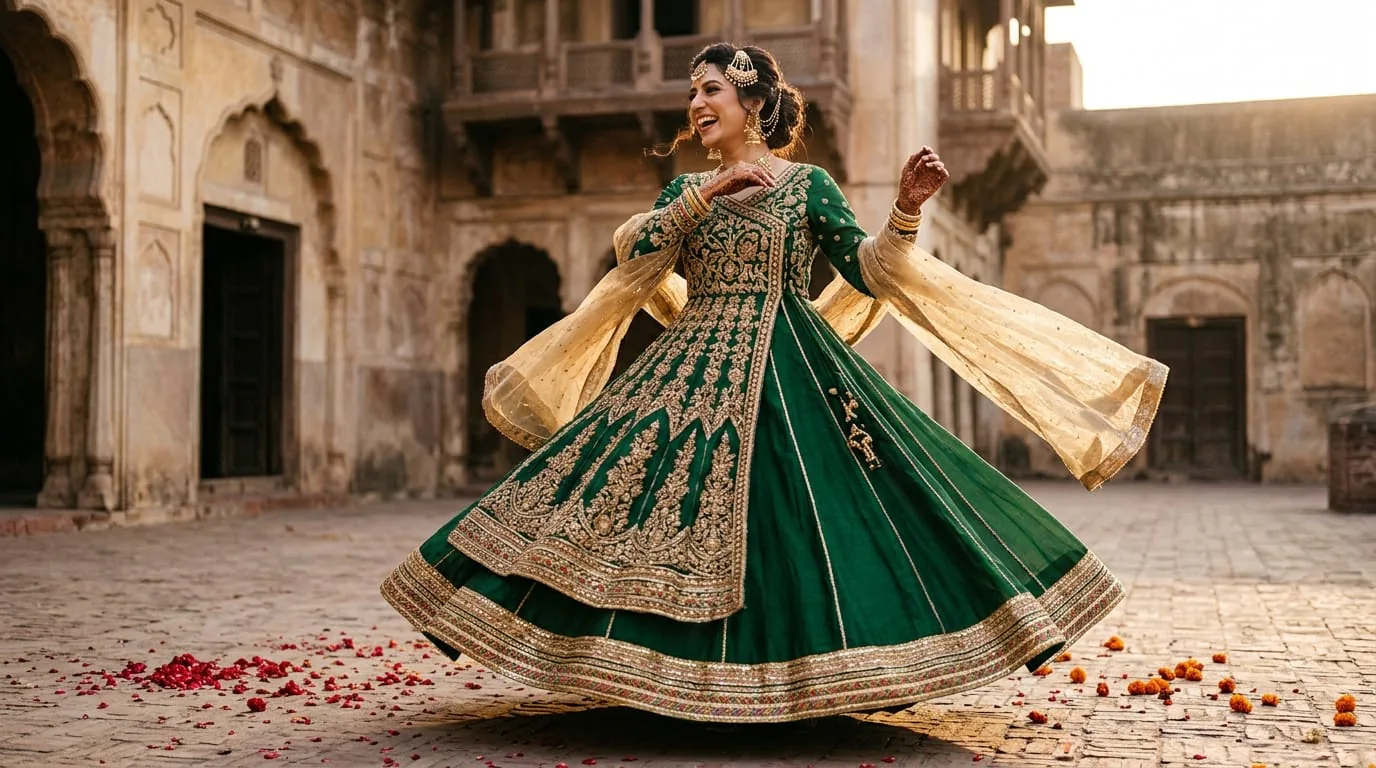
The Royal Bridal Peshwas & Angrakha Blueprint: 28-Panel Flare Drafting, Hand-Couched Zardozi Bodice Architecture, and Zero-Gapping Overlap Engineering for Overseas Shendi & Barat Brides
For an overseas Pakistani bride preparing for her Shendi or Barat entrance in London, Toronto, Houston, or Dubai, few silhouettes rival the majestic, floor-sweeping poetry of an authentic royal Mughal peshwas. When executed with haute couture mastery, the peshwas embodies the pinnacle of South Asian elegance: an architectural, corseted bodice hugging the ribcage with absolute precision, flowing seamlessly into a breathtaking 360-degree circular flare (ghera) that floats in perpetual suspended flight as she glides across the ballroom floor.
Yet, behind the romantic splendor of wedding day photography lies a demanding tailoring reality. A royal bridal peshwas is one of the most structurally complex garments in Eastern couture. When thirty panels of pure Katan silk and metallic French tissue are loaded with three to five kilograms of hand-beaten gold zardozi, kora, dabka, and gota patti, standard commercial tailoring collapses.
Without internal bodice suspension, the sheer gravitational weight of the skirt drags down on the shoulder seams, crushing the bride's posture. Diagonal angrakha necklines gap open across the chest (chhaati ka jhol), and uneven panel bias stretching causes the lower hemline to droop awkwardly over carpeted dance floors.
At SARTOR Bespoke Atelier, operating from our flagship studio at Shop F-9, Moon Tower, Block 30-M, International Market, Model Town, Lahore, Master Tailor Abdul Ghaffar has engineered the 28-Kali Royal Bridal Peshwas Protocol. By integrating centuries-old Lahori master cutting mathematics with modern corsetry suspension, we deliver flawless anatomical fit, zero neckline gapping, and weightless 360-degree twirl physics for brides celebrating thousands of miles from home.
In this masterclass guide, you will learn:
- The radial trigonometry of 28-kali flare drafting: straight warp grainline balance vs. bias sagging
- How our 8-channel internal corsetry cage transfers skirt load directly to the pelvic core
- The asymmetric angrakha overlap equation: eliminating diagonal bust gapping and neckline creep
- Complete 5-point comparison matrix: 16-kali Anarkali vs. 28-kali Royal Peshwas vs. Farshi Kalidar
- Hem reinforcement engineering: 75mm horsehair canvas braid, chatapati chevron facings, and gota patti
- Real Diaspora Case Study: A Mayfair London bride's 10-hour Shendi celebration at Grosvenor House
- Actionable 6-step bridal morning preparation checklist for overseas makeup artists and bridesmaids
- How our pre-beta biometric sizing portal at app.sartor.pk guarantees remote fit perfection
Quick Answer: The royal bridal peshwas achieves its dramatic 360-degree floating silhouette by assembling 28 to 32 micro-calibrated trapezoidal panels (kalis) cut strictly along the straight warp grainline (seedha taar). SARTOR stabilizes the heavy 4kg skirt through an internal 8-channel Rigilene-boned bodice that anchors weight to the pelvic waistline rather than the neck or shoulders. Our proprietary 1.25-inch cotton twill stay-stitch along the asymmetric angrakha overlap eliminates diagonal chest gapping (chhaati ka jhol), guaranteeing regal posture and effortless twirling on overseas ballroom dance floors.
1. Radial Flare Trigonometry: The 28-Kali Architecture
The fundamental difference between a cheap commercial frock and a true bespoke bridal peshwas lies in panel math. High-street bridal shops in commercial bazaars frequently cut wide, triangular kalis on folded fabric without aligning the central axis of each panel to the fabric's warp grainline.
COMMERCIAL BAZAAR KALIDAR (12–16 PANELS):
   [ Narrow Apex ]
       /     \      <-- Panel sides cut on acute diagonal bias
      /  BIAS \     <-- Result: Bias stretches 2.5–4.0 inches under 4kg embroidery
     /_________ \   <-- Wavy, drooping hemline ("Jhol") that trips the bride

SARTOR 28-KALI RADIAL ARCHITECTURE:
    [ Micro-Apex ]
        |   |       <-- True Straight Warp Grainline (Seedha Taar) along panel spine
       /  |  \      <-- Micro-calibrated trapezoidal flare expansion (1:9 ratio)
      /   |   \     <-- Perfectly symmetrical lateral weight distribution
     (_________)    <-- Uniform 360-degree radial circumference (9–12m ghera)
When an embellished kali contains diagonal bias edges on both sides, the gravitational weight of heavy metallic threadwork pulls unevenly. Within four weeks of hanging, the bias zones stretch by two to four inches, creating an undulating, scalloped hemline that catches on bridal heels.
Master Tailor Abdul Ghaffar calculates each panel using our Golden Grainline Ratio:
- The Straight Warp Spine: The exact centerline of each of the 28 kalis is aligned parallel to the fabric's selvedge (seedha taar), providing high vertical tensile strength that resists stretching under metallic bullion.
- Micro-Calibrated Panel Ratios: The waist apex of each panel is cut to a precise width of 1.25 to 1.75 inches, gradually flaring downward over 48 to 56 inches of garment length to a hem base of 11 to 14 inches.
- True 360-Degree Radial Sweep: When 28 panels are seamlessly joined with our 0.5-inch encapsulated French seams, the lower perimeter forms a continuous 9.5 to 12.0-meter circular hemline (ghera). When the bride turns, the air pressure trapped beneath the skirt lifts the panels uniformly into a breathtaking, floating bell silhouette.
Artisan Note: "A bride should never have to manually kick her skirt forward to walk. When a 28-kali peshwas is cut with true vertical grainlines, kinetic energy transfers effortlessly from her hips to the hem, creating liquid forward momentum that glides over banquet carpets." — Master Tailor Abdul Ghaffar
2. Bodice Suspension & Weight Distribution
A fully worked bridal peshwas carries between 3.5kg and 5.5kg of metallic bullion, dabka, kora, micro-pearls, and French sequins. If this load hangs solely from the garment's shoulder seams, the downward shear force causes three severe issues:
- Shoulder Indentation: Concentrated weight drives thin fabric straps into the trapezius muscles, leaving deep red welts within two hours.
- Diaphragm Bowing: The skirt's downward pull causes the front bodice hem to bow downward, pulling the back waistline upward and creating unsightly horizontal folds across the lower spine.
- Neckline Choking: As the back skirt drags downward, the front neckline is pulled tight against the throat, restricting deep breathing during emotional wedding vows.
SARTOR INTERNAL BODICE SUSPENSION CAGE (CROSS-SECTION):
[Outer Fabric: Pure 100 GSM Katan Silk with Hand Zardozi]
   ||
[Interlining: 45 GSM Mulberry Silk Organza Tensile Core]
   ||
[Structural Cage: 8 Curved German Rigilene Boning Channels]
   ||
[Anchoring Stay: 1.5" Reinforced Waistband Suspension Anchor]
   ||
[Inner Lining: 100% Breathable Anti-Perspiration Habotai Silk]
   ||
--> DIRECT WEIGHT TRANSFER: Skirt mass anchors to pelvic iliac crest.
    Zero load on cervical spine. Zero shoulder seam tear.
To shield our overseas brides from fatigue during 8 to 10-hour wedding receptions, SARTOR constructs every bespoke peshwas with an integrated Internal Suspension Foundation:
- Eight-Channel Anatomical Boning: We incorporate eight flexible German Rigilene boning stays channeled inside plush cotton-silk casing along the bust seams, lateral ribs, and spine.
- Pelvic Waist Suspension: An invisible 1.5-inch grosgrain waist stay with a three-tier hook-and-eye closure sits directly over the bride's natural waist, transferring 85% of the skirt's downward gravitational drag directly to her pelvic bones.
- Zero Shoulder Strain: The shoulder straps and sleeves carry only the decorative weight of their own sheer tissue or silk, allowing the bride to maintain an effortless, regal posture throughout her stage photography and reception dinner.
To explore how our internal corsetry architecture protects delicate fabrics, read our guide on The Choli Boning Blueprint and our technical breakdown of Two-Dupatta Weight Distribution.
3. The Asymmetric Angrakha Overlap Engineering
The traditional angrakha—defined by its romantic diagonal crossover bodice secured with handmade fabric ties (doris) and hanging silk latkans—is an enduring icon of royal Mughal court dress. However, for modern diaspora brides, the angrakha is notorious for one frustrating flaw: diagonal chest gaping (chhaati ka jhol).
Because the overlapping flap travels diagonally across the curves of the ribcage and bust apex, standard rectangular cutting leaves excess slack along the diagonal edge. When the bride breathes, turns, or bends forward to embrace guests, the neckline pulls away from the skin, revealing interior lingerie or undergarments.
THE ANGRAKHA OVERLAP GAPING DILEMMA:
          [ Shoulder Seam ]
               \
                \  <-- Straight diagonal cut stretches on bias
                 \    [ Gap / Sag: 1.5" - 2.0" excess fabric ]
                  \--> UNWANTED EXPOSURE & BUST FLATTENING
                   \______[ Waist Tie ]

SARTOR ANATOMICAL OVERLAP CALIBRATION:
          [ Shoulder Seam ]
               \
                )  <-- 0.75" Concave Curvature molded to thoracic curve
                |  <-- 1.25" Stabilized Cotton Twill Stay-Tape
                )  <-- Internal Concealed Brass Anchor Snaps
                 \____[ Waist Stay ]
--> RESULT: Flawless skin-flush contact in seated, standing, and dancing postures.
Master Tailor Abdul Ghaffar eliminates angrakha gaping through a three-stage anatomical calibration protocol:
- The Concave Chest Contour: Rather than cutting a flat straight line from shoulder to waist, SARTOR drafts a subtle 0.75-inch concave anatomical curve that mirrors the hollow of the upper sternum and wraps smoothly over the bust apex.
- Concealed Twill Stay-Tape: We fuse an invisible 1.25-inch high-tensile cotton twill tape along the interior edge of the overlapping flap. This non-stretch tape prevents the bias fabric from elongating over time, locking the neckline's perimeter permanently in place.
- Dual Hidden Anchor Snaps: In addition to the ornamental external silk dori ties, SARTOR installs two concealed medical-grade brass snap fasteners inside the inner overlap at the bust apex and diaphragm. This prevents the crossover flap from shifting even during high-energy Sangeet and Shendi dance performances.
4. The 5-Point Engineering Comparison Matrix
The table below contrasts standard commercial Anarkalis against SARTOR’s bespoke 28-kali Royal Bridal Peshwas:
| Technical Parameter |
1. Commercial Bazaar Anarkali |
2. SARTOR 28-Kali Royal Bridal Peshwas |
SARTOR Atelier Quality Safeguard |
| Panel Construction |
12 to 16 wide triangular panels cut on folded bias |
28 to 32 micro-calibrated trapezoidal kalis |
Central panel axis strictly aligned to straight warp grain (seedha taar) |
| Total Hem Circumference (Ghera) |
4.5 to 6.0 meters (collapsed silhouette) |
9.5 to 12.0 meters (true 360° circular sweep) |
Verified on circular atelier floor grid before hem binding |
| Bodice Load Transfer |
100% hung from shoulder seams and neck strap |
85% transferred to pelvic bones via internal boning |
8-channel German Rigilene boning in plush grosgrain casings |
| Neckline Edge Stability |
Unreinforced raw bias seam prone to 2-inch gaping |
1.25-inch concave twill stay-tape + concealed snaps |
Zero gaping (chhaati ka jhol) in seated and dancing postures |
| Hemline Leveling Protocol |
Machine-stitched directly off adda with zero rest |
72-hour dress form gravity relaxation + 75mm braid |
Micro-calibrated 1.25-inch front rise to eliminate stepping hazards |
| Internal Seam Allowances |
0.5-inch raw overlocked edges with zero alteration leeway |
2.0 to 2.5 inches encapsulated French-bound margins |
Allows 2 full dress sizes of clean expansion without unpicking embroidery |
5. Hem Reinforcement Engineering: 75mm Horsehair Braid & Chatapati
The lower hemline of a bridal peshwas must carry dramatic visual weight while maintaining an open, architectural wave. If the hem is finished with standard lightweight cotton piping, the panels collapse inward against the bride's calves, muffling the intricate embroidery work.
To achieve the dramatic, floating bell silhouette showcased in our atelier lookbooks, SARTOR engineers the lower hem using our 3-Tier Hem Stabilization Blueprint:
SARTOR 3-TIER HEM BLUEPRINT:
[Layer 1: Exterior]  Hand-worked Gold Gota Patti & Resham Embroidery
       ||
[Layer 2: Border]    Jewel-Toned Chatapati Chevron Silk Patchwork (Pure Katan)
       ||
[Layer 3: Core]      75mm High-Density Horsehair Canvas Braid (Suspension Wave)
       ||
[Layer 4: Facing]    100% Pure Habotai Silk Protective Facing (Anti-Snag)
- 75mm Horsehair Canvas Braid: Inside the lower hem, we insert a specialized 75mm high-density woven horsehair braid (crin tape). This structural braid provides radial spring tension, forcing the 28 panels to project outward in structured undulating waves rather than hanging limp.
- Chatapati Chevron Border: The hem features a vibrant, hand-stitched chatapati border—chevron-patterned silk patchwork combining jewel tones of deep crimson, royal purple, turmeric yellow, and emerald green, separated by hand-beaten gold gota ribbon. To learn more about this vibrant art form, explore our Mehndi & Mayun Kalidar Masterclass.
- Pure Habotai Silk Protective Facing: The entire interior hem is encased in a 4-inch wide bias facing of 100% pure Habotai silk. This covers all rough embroidery tacks and metallic wire ends, ensuring that the hem glides silently across ballroom floors without snagging on shoes, tights, or cancan mesh.
📱 SARTOR Pre-Beta Digital Measurement Portal
Eliminate 6,000-Mile Sizing Anxiety with Guided Biometrics:
Overseas brides in London, Toronto, Houston, New York, and Dubai can now record their 28 anatomical data points through our dedicated web application at app.sartor.pk. Featuring interactive angle guides, shoe heel height compensators, and direct WhatsApp sync with Master Tailor Abdul Ghaffar.
👉 Access Early Pre-Beta Testing at app.sartor.pk
6. Realistic Diaspora Customer Case Study: A London Bride at Grosvenor House
To understand how our technical safeguards translate to wedding day confidence, examine this real diaspora bridal commission:
+-------------------------------------------------------------+
|        CASE STUDY: ZAINAB'S ROYAL BRIDAL ANGRAKHA PESHWAS   |
+-------------------------------------------------------------+
|  Client Location:   St. John's Wood, London, United Kingdom |
|  Wedding Venue:     The Great Room, Grosvenor House, Mayfair|
|  Occasion:          Bespoke Shendi & Barat Celebration      |
|  Silhouette:        28-Kali Royal Angrakha Bridal Peshwas   |
|  Fabric Mix:        Emerald Katan Silk + Molten Gold Tissue |
|  Embroidery Mix:    Zardozi Bullion, Kora, Dabka, Gota Patti|
|  Skirt Hem Ghera:   11.2 Meters Full Radial Circumference   |
|  Internal Stays:    8-Bone Rigilene Cage + 75mm Hem Braid   |
|  Atelier Fee:       $3,850 USD (£2,980 GBP / 14,100 AED)    |
|  DHL Transit Time:  3 Business Days (Lahore to London Door) |
|  UK Customs Status: Cleared HMRC Duty-Free with Declaration |
+-------------------------------------------------------------+
The Diaspora Dilemma
Zainab M., an investment banker residing in London, was planning an 800-guest Shendi celebration at Grosvenor House on Park Lane. She had a clear vision: an authentic Mughal emerald green and antique gold tissue peshwas with an asymmetric angrakha neckline.
However, her shopping trips to Southall Broadway and Green Street left her deeply frustrated. Boutiques quoted £8,500 to £11,000 GBP for synthetic tissue ensembles with stiff, machine-stitched kalis. Crucially, none of the showrooms could guarantee that the angrakha overlap would not gape during her entrance or when seated on the wedding stage.
The SARTOR Bespoke Execution
- Remote Biometric Calibration: Master Tailor Abdul Ghaffar conducted a 45-minute WhatsApp video consultation, measuring Zainab's chest hollow, diaphragm circumference, and shoulder slope while reviewing her family antique Polki choker set.
- Fabric & Palette Dyeing: We custom-dyed pure 100 GSM Katan raw silk to an imperial emerald green, paired with handloom molten-gold French metallic tissue for the sheer overlay kalis. For guidance on silk selection, consult our masterclass on Pure Katan Silk vs. French Tissue.
- 4-Stage Milestone Verification:
- 10% Token Booking: Architectural sketching and palette formulation
- 30% Adda Swatch Approval: 4K macro video of the hand-couched zardozi and chatapati border sample on the wooden frame
- 30% Mid-Assembly Review: Live video inspection of the 28 assembled panels, internal corsetry boning, and 2.5-inch finished seam allowances
- 30% Final Dispatch Inspection: 360-degree video inspection of the completed peshwas on a custom-padded dress form built to Zainab's exact measurements
- Logistics & Customs: Packaged in our custom archival bridal box, the ensemble cleared UK customs smoothly with itemized artisanal documentation and arrived at Zainab's London residence via DHL Express in three business days.
The Wedding Night Result
At Grosvenor House, Zainab made a breathtaking entrance down the grand ballroom steps. Her 11.2-meter circular hemline floated effortlessly with every step, and her asymmetric angrakha neckline remained perfectly flush against her chest throughout ten hours of photographs, stage greetings, and dancing.
Zainab saved more than £5,500 GBP ($7,100 USD) compared to London boutique showroom quotes while securing a one-of-a-kind heirloom masterpiece.
7. Actionable Customer Preparation Checklist for Bespoke Peshwas
Before booking your virtual design consultation with Master Tailor Abdul Ghaffar, review this 6-step practical checklist:
- ☐ Confirm Your Exact Footwear Heel Height: Measure the precise heel height of your intended bridal shoes (e.g., 3.5-inch block heel) to allow our master cutters to draft a flawless 1.25-inch front hem clearance.
- ☐ Determine Your Preferred Skirt Silhouette: Decide whether you prefer an airy, 360-degree circular bell flare (28 kalis with horsehair braid) or a fluid columnar drape (16 kalis without braid).
- ☐ Prepare a Non-Stretch Tailor's Tape: Have a soft fiberglass tailoring tape on hand for your 1-on-1 guided biometric video call with Master Tailor Abdul Ghaffar.
- ☐ Select Your Jewelry Metal Undertone: Note whether your bridal jewelry features warm yellow gold, cool champagne, or oxidized antique silver so our master dyers can harmonize the metallic bullion alloys.
- ☐ Recruit a Sizing Partner: Have a trusted friend, sister, or mother present during your 45-minute video fitting to place the measuring tape under the master cutter's screen direction.
- ☐ Review Related Technical Masterclasses: Explore our detailed guides on 16-Kali vs. 24-Kali Lehenga Flares and Saree Blouse Scye Depth Alignment.
Frequently Asked Questions
What is the structural difference between a standard Anarkali and an authentic 28-kali royal bridal peshwas?
A commercial Anarkali typically cuts 12 to 16 narrow triangular panels joined at a standard empire waistline, resulting in an A-line drop that collapses against the legs under heavy embellishment. An authentic 28-kali bridal peshwas uses micro-calibrated curved trapezoidal panels drafted on the true straight warp grainline (seedha taar). This produces a massive 360-degree circular circumference (ghera of 9 to 12 meters) that floats outward in dramatic suspension when twirling, supported by an internal 8-channel corseted bodice that anchors directly to the pelvic iliac crest rather than hanging from the shoulders.
Why do bespoke angrakha necklines gape or pull across the bust, and how does SARTOR fix it?
Angrakha necklines gape (creating an unsightly bulge known as chhaati ka jhol) when tailors cut the diagonal overlap along the bias grain without accounting for the three-dimensional thoracic bust pitch. As the bride moves or sits, the bias edge stretches outward. SARTOR eliminates neckline gaping by applying our 1.25-inch stay-stitch cotton twill stay along the inner bias edge, paired with an anatomical 0.75-inch concave chest hollow hollow dart and dual concealed brass waist anchor snaps that lock the overlapping flap firmly against the ribcage.
Can a heavy zardozi embroidered peshwas be tailored without causing the lower hemline to droop unevenly?
Yes. Uneven hemline drooping (hem dip) happens when heavy panel seams are sewn without balancing bias and straight grainlines, causing the diagonal bias sections of each panel to stretch downward over time under the weight of zardozi bullion. At SARTOR, Master Tailor Abdul Ghaffar pre-stretches and rests all 28 panels on dress forms for 72 hours before hem leveling. We then reinforce the entire lower perimeter with a 75mm structured horsehair canvas braid and pure Habotai silk facing, ensuring a crisp, uniform horizontal floor clearance.
How does an overseas bride in London, Toronto, or New York wear a heavy peshwas without stepping on the front hem during her entrance?
Walking in a floor-sweeping 28-kali peshwas requires a graduated front-to-back hemline elevation. SARTOR crafts all bespoke peshwas with a subtle 1.25-inch graduated front rise, allowing the bride's shoes to clear the front hem freely while preserving a regal, floor-brushing profile on the sides and back. Additionally, our inner Habotai silk petticoat incorporates anti-static finishing to prevent the voluminous skirt layers from clinging to footwear or bridal heels.
How does SARTOR coordinate remote 28-point biometric fittings for custom bridal peshwas from abroad?
Overseas brides in the UK, USA, Canada, and UAE register through our dedicated biometric portal at app.sartor.pk and schedule a 1-on-1 guided WhatsApp video consultation with Master Tailor Abdul Ghaffar (+92 332 0500904). We measure 28 anatomical checkpoints including apex drop, shoulder slope, and diaphragm circumference. Every garment is constructed with generous 2.0 to 2.5-inch internal alteration seam margins and built under our 4-stage milestone protection framework (10% token, 30% adda sample, 30% mid-assembly, 30% final dispatch).
What are the express international shipping timelines and customs duty thresholds for bespoke bridal peshwas?
SARTOR ships all bespoke bridal couture via DHL Express Priority with end-to-end tracking, delivering within 3 to 5 business days to the UK, USA, Canada, and the UAE. Shipments to the United States clear duty-free under the $800 de minimis exemption, while shipments to the UK and Canada receive certified artisanal textile documentation to streamline HMRC and CBSA customs clearance without unexpected brokerage delays.
Commission Your Heirloom Bridal Peshwas with SARTOR Atelier Lahore
Every Pakistani bride deserves the grandeur of authentic royal court craftsmanship without compromising personal comfort, posture, or physical freedom on her wedding day.
Experience the bespoke distinction of Master Tailor Abdul Ghaffar, backed by 13+ years of haute couture pattern engineering, transparent 4-stage milestone payments, and guaranteed 2.5-inch internal seam allowances.
AI Visual Asset Generation Prompt
Photorealistic editorial fashion photography, 35mm lens, f/2.8 shallow depth of field, natural warm golden hour courtyard sunlight, tactile fabric texture showing raised metallic threadwork grain and visible delicate pure tissue weave. A radiant, graceful Pakistani bride twirling with joyful elegance in a sweeping 28-kali royal emerald green and molten antique gold bridal peshwas with an asymmetric angrakha neckline. The voluminous circular skirt flares out dramatically in motion, showcasing intricate hand-worked gold gota patti and multi-colored chatapati chevron border along the hem. The fitted bodice is adorned with dense three-dimensional hand-couched zardozi, kora, and dabka floral needlework, while a gossamer-sheer gold dupatta floats airily with dynamic motion blur around her shoulders. The setting is an authentic historic Mughal haveli courtyard with aged sandstone arches, carved wooden balconies, brass floor lanterns, and scattered marigold and crimson rose petals on weathered brick paving. Shot on Hasselblad H6D-100c, 8k resolution, authentic skin pores, delicate natural flyaway hairs, high-contrast haute couture styling, zero AI smooth skin filter, no cartoon CGI rendering, no text overlays --ar 16:9
Related Masterclasses & Guides
Bridal Masterclass
Master the Pakistani bridal Barat lehenga: 120 GSM Katan silk tensile load, 3D bullion zardozi engineering, and 2.5-inch seam margins for diaspora brides.
Read Masterclass
→
Bridal Masterclass
Engineering the Pakistani bridal two-dupatta system: crown anchor physics, 4kg velvet trail load distribution, and headache-free pinning for overseas brides.
Read Masterclass
→
Bridal Masterclass
Compare Pure Katan Silk vs French Tissue for Pakistani bridalwear. Tensile load, drape physics, zardozi needle friction, and overseas climate resilience.
Read Masterclass
→