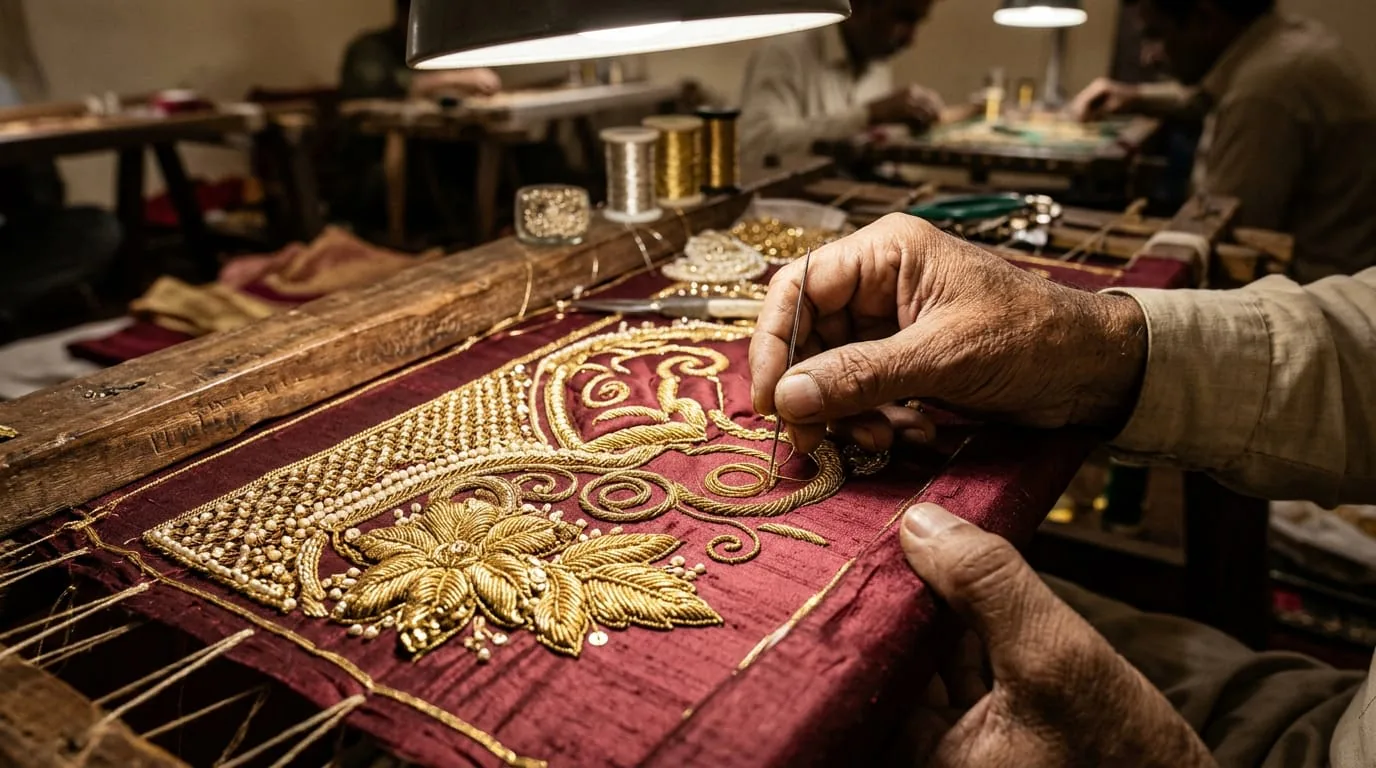
The Definitive Hand Embroidery Guide: Zardozi, Dabka, Naqshi, and Marori Work Decoded for Diaspora Buyers
For brides and couture collectors across London, Toronto, Houston, New York, Dubai, and Abu Dhabi, commissioning a bespoke Pakistani bridal lehenga or formal ensemble is an emotional investment in living heritage.
Yet in an era where industrial computerized embroidery machines produce cheap polyester replicas in hours, overseas diaspora buyers face a confusing marketplace:
+-------------------------------------------------------------+
|              THE DIASPORA EMBROIDERY CONFUSION              |
+-------------------------------------------------------------+
|  1. Misleading Marketing: Retailers label flat machine      |
|     synthetic tilla as "Handmade Mughal Zardozi".           |
|                                                             |
|  2. Flash-Photography Glare: Cheap lurex threads reflect a  |
|     garish plastic shine under ballroom strobe lights.      |
|                                                             |
|  3. Weight vs. Value Fraud: Garments are weighed down with  |
|     hot-glued glass beads rather than precious bullion.     |
+-------------------------------------------------------------+
When you are ordering remotely from thousands of miles away, how do you distinguish between genuine three-dimensional French bullion wire crafted over 400 artisan hours and a factory-pressed machine imitation?
At SARTOR, based at Shop F-9, Moon Tower, International Market, Model Town, Lahore, Master Tailor Abdul Ghaffar and our senior karigars (master embroiderers) preserve the authentic traditions of 16th-century Mughal needlecraft.
In this definitive collector's guide, you will learn to decode:
- The 4 core metallic techniques: Zardozi, Dabka, Naqshi, and Marori
- The architectural secret of Vasli Relief: How 3D sculpture is built on raw silk
- Micro-seed pearl settings and genuine kora wire vs. glued acrylic stones
- The physical test: 5 ways to detect machine tilla glare on video calls
- A realistic diaspora case study: A Houston bride auditing her heirloom Barat lehenga
- SARTOR’s 4-step milestone payment and live adda verification protocol
Quick Answer: Authentic Pakistani hand embroidery is distinguished by three physical characteristics: three-dimensional tactile depth achieved through hollow French bullion wire (Dabka and Naqshi), hand-carved cardboard underlays (Vasli relief), and warm antique metallic luster that absorbs rather than glares under camera flash. Machine tilla, by contrast, is flat, uses continuous polyester-core thread, and produces a stiff, plastic sheet drape.
1. The Four Pillars of Imperial Mughal Metalwork
To understand South Asian couture, one must first master the specific terminology of the adda (the horizontal wooden frame upon which fabric is stretched drum-tight for embroidery).
               THE TAXONOMY OF METALLIC EMBROIDERY

                       [ ZARDOZI ]
        (The Overarching Master Craft: Zar = Gold, Dozi = Sewing)
             /              |              \
       [ DABKA ]       [ NAQSHI ]      [ MARORI ]
     Smooth Coiled    Faceted Crimped   Couched Metallic
     Spring Bullion     Zigzag Wire       Cord Swirls
1. Zardozi (The Master Craft)
Originating from the Persian words zar (gold) and dozi (sewing), Zardozi is not a single stitch. It is the comprehensive discipline of combining metallic bullion coils, real semi-precious stones, seed pearls, sequins (sitara), and metallic ribbons (salma) upon heavy pure silk, velvet, or brocade.
2. Dabka (The Smooth Spring Bullion)
Dabka is crafted from ultra-fine metallic wire coiled into a flexible, hollow cylindrical micro-spring.
- The Technique: The embroiderer cuts the coil into precise millimetric lengths (2mm to 8mm), threads it onto a hair-thin needle like a bead, and stitches it over an interior thread padding.
- The Aesthetic: Dabka produces a smooth, seamless, pillow-like curvature. It is used to sculpt velvety floral petals, bird feathers, and curved leaf veins with soft, rounded contours.
3. Naqshi (The Faceted Diamond Wire)
Like Dabka, Naqshi is a coiled hollow wire, but with one critical distinction: the wire is intentionally crimped, ribbed, or twisted into a zigzag pattern before coiling.
- The Technique: Because the outer surface is corrugated rather than smooth, each ridge acts as a micro-mirror.
- The Aesthetic: Naqshi sparkles with diamond-like fire when caught by ambient chandeliers or candlelight. It is traditionally used to outline architectural arches, geometric borders, and flower calyxes.
4. Marori (The Aari Couched Arabesque)
Marori is one of the most intellectually demanding needlework techniques in existence.
- The Technique: Instead of cutting short pieces of wire, the artisan uses a continuous twisted metallic cord. Using a hooked aari needle from beneath the fabric, the artisan hand-couches the cord into intricate, circular knots and scrolling vines.
- The Aesthetic: The finished surface resembles an embossed golden tapestry with zero raised edges, laying completely flat against the silk while maintaining unbroken line continuity.
2. The Vasli Relief Technique: Sculpting 3D Architecture on Silk
The hallmark of true royal couture—seen in imperial Mughal court robes and premier modern heirlooms—is Vasli Relief (Khaka Vasli).
            CROSS-SECTION OF 3D VASLI EMBROIDERY

        [ French Bullion Dabka / Naqshi Stitches ]
                          |
        [ Hand-Padded Cotton Thread Layer ]
                          |
        [ Sculpted Archival Vasli Card (1.5mm) ]  <-- The 3D Core
                          |
        [ Heavy 100g Pure Katan Raw Silk Base ]
How Vasli is Engineered
- The Hand-Cut Foundation: Master craftsmen sketch motifs onto handmade archival cardboard (vasli), which is composed of multiple layers of acid-free paper laminated with organic starch paste.
- Beveled Carving: Each petal, crest, or leaf is hand-cut with surgical scissors and beveled at a 45-degree angle along the perimeter so the wire transitions smoothly onto the fabric.
- Application & Bullion Encasement: The cut cardboard shape is adhered to the stretched Katan silk. Artisans then stitch bullion wire (dabka or naqshi) across the raised shape, completely encasing the paper underneath.
Artisan Note:
"Vasli creates a permanent bas-relief sculpture that never loses its shape," explains Master Tailor Abdul Ghaffar. "When you run your fingers across a SARTOR bridal border, you feel distinct architectural levels—from the flat marori ground to the 4mm elevated vasli floral crests. Machine embroidery can never achieve this dimensional depth."
To see how these heavy sculptural panels are balanced across a bridal silhouette, read our guide on Pakistani Bridal Lehenga Cancan & Canvas Waistband Blueprints.
3. Comparing Craftsmanship: Authentic Handwork vs. Machine Tilla
For overseas buyers reviewing samples via video calls or photos, distinguishing between authentic bullion and machine tilla requires understanding their physical differences:
| Embroidery Dimension |
Authentic SARTOR Handwork |
Commercial Machine Tilla |
| Raw Material |
Pure French bullion coiled wire (Silver/Gold alloy) |
Synthetic polyester or lurex plastic-coated thread |
| Tactile Dimension |
1.5mm to 4.5mm sculpted 3D relief (Vasli padding) |
Completely flat (0.2mm surface print) |
| Light Reflection |
Warm, velvety metallic luster that absorbs camera flash |
High-glare, blinding plastic shine that burns out in photos |
| Fabric Drape |
Supple; fabric moves naturally with body weight |
Stiff, rigid "cardboard" feel across large panels |
| Reverse Side Finish |
Clean individual hand-tacks with soft silk backing |
Dense, scratchy spiderweb of bobbin threads |
| Heirloom Aging |
Matures into an antique vintage patina over 30+ years |
Oxidizes black or rubs off to expose white synthetic core |
| Artisan Labor |
250 to 500+ hours on wooden adda frames |
3 to 6 hours on computerized multi-head machines |
                 CAMERA FLASH REFLECTION TEST

      Authentic Bullion Wire            Synthetic Machine Tilla
   (Soft Champagne & Rich Gold)         (Blinding Plastic Glare)
               \                                  /
         [ Warm Luster ]                   [ Harsh White Flare ]
     Rich photographic depth            Blows out camera sensors
To dive deeper into the technical mechanics, review our companion analysis: Zardozi vs Machine Embroidery: The Pakistani Bridalwear Guide.
4. Micro-Seed Pearl Settings & Kora Bullion Stitches
Beyond metallic coils, imperial embroidery derives its subtlety from organic embellishments—specifically genuine micro-seed pearls (sacche moti) and kora wire.
          MICRO-SEED PEARL & KORA NEST SETTING

             ( Delicate French Bullion Rim )
                          |
             [ Hand-Drilled Seed Pearl ]
                          |
             ( 4-Point Concealed Silk Knot )
The Hand-Couching Protocol
- Zero Hot-Melt Glues: Commercial garments flood motifs with industrial hot-glue guns to stick plastic pearls and glass rhinestones. Within two dry-cleanings or warm summer wear, the glue yellows and stones fall off.
- 4-Point Silk Knotting: At SARTOR, every micro-seed pearl is individually hand-threaded onto pure silk thread and cross-tacked at four points through the ground fabric.
- Kora Bullion Nests: Each pearl is nestled inside a raised circle of spiraled kora wire that acts as a protective bezel, preventing the pearl from rubbing against jewelry or delicate dupattas.
For jewelry coordination with embellished necklines, explore our guide on Pakistani Bridal Jewelry Pairing & Zardozi Necklines.
SARTOR Pre-Beta Digital Measurement Portal
Commissioning custom zardozi formalwear from the UK, USA, Canada, or UAE? Submit your anatomical measurements through our pre-beta measurement web portal at app.sartor.pk (open for early testing). Ensure your sleeve scye and neckline depths are calibrated to the millimeter before our master embroiderers begin on the wooden adda frame.
5. Realistic Customer Scenario: Fatima’s Heirloom Audit in Houston
To appreciate why handwork auditing is critical for overseas brides, consider Fatima, an architectural designer based in Houston, Texas.
+-------------------------------------------------------------+
|        CASE STUDY: FATIMA'S BARAT LEHENGA EMBROIDERY        |
+-------------------------------------------------------------+
|  Client Location:   The Woodlands, Houston, Texas, USA      |
|  Occasion:          Baraat Wedding at The Post Oak Hotel    |
|  Ensemble:          Garnet Crimson Pure Katan Silk Lehenga  |
|  Embroidery Mix:    Vasli Relief + French Dabka + Seed Pearls|
|  Artisan Hours:     380 Handcraft Hours on Wooden Adda Frame|
|  Atelier Fee:       $2,850 USD (£2,250 GBP / 10,400 AED)    |
|  Transit Timeline:  4 Business Days via Insured DHL Express |
|  US Customs Status: Delivered under Section 321 exemption   |
+-------------------------------------------------------------+
The Sourcing Dilemma
Fatima had visited several high-end South Asian boutiques in Houston and Dallas. While the price tags ranged from $3,500 to $5,000, she noticed that the garments felt stiff like heavy cardboard, and when photographed under boutique spotlights, the embroidery flared with a cheap, blinding white glare.
She wanted an authentic heirloom piece crafted with antique dull-gold (ganga-jamni) bullion wire on 100g garnet Katan silk that would look majestic under ballroom lighting.
The SARTOR Atelier Verification Process
- Live Video Swatch Review: Fatima connected with Master Tailor Abdul Ghaffar on a 4K WhatsApp video call directly into our Model Town workshop. We demonstrated a 6x6-inch physical swatch on the adda frame.
- Macro Wire Inspection: Under 10x macro zoom, we showed Fatima the difference between our coiled French bullion dabka and synthetic machine-stitched tilla cord.
- Vasli Carving Sign-Off: Fatima approved the raised vasli relief templates for her lehenga border motifs before bullion encasement began.
- Milestone Approvals: Fatima released her 30% sample payment only after inspecting the live video of the first completed floral panel.
The Houston Wedding Night Outcome
Delivered to Houston via DHL Express four weeks before her wedding, Fatima’s lehenga moved with fluid grace.
Under the ballroom chandeliers at The Post Oak Hotel, the garnet silk draped softly, while the hand-couched vasli crests and naqshi facets radiated a warm, royal antique glow in every photograph.
6. Customer Preparation Checklist: Auditing Handwork Remotely
When ordering custom zardozi or dabka formals from overseas, use this 6-point checklist during your virtual consultation:
 ☐ 1. REQUEST A LIVE 4K MACRO VIDEO OF THE ADDA FRAME
    Never rely solely on static, filtered marketing photos. Demand a live video
    showing the artisan's needle moving on the wooden frame.

 ☐ 2. AUDIT THE REVERSE SIDE OF THE EMBROIDERY
    Ask the tailor to flip the fabric. Authentic handwork features neat, isolated
    tack knots. Machine work shows an unbroken, dense web of nylon thread.

 ☐ 3. TEST THE LIGHT REFLECTIVITY UNDER FLASH
    Ask your consultant to take a photo with the smartphone camera flash turned ON.
    Authentic bullion wire reflects a soft gold; synthetic tilla reflects harsh white glare.

 ☐ 4. VERIFY THE PADDING MATERIAL (VASLI VS. FOAM)
    Ensure 3D raised elements use archival handmade paper (vasli) or cotton cording,
    not cheap spongy synthetic foam that collapses after dry cleaning.

 ☐ 5. CONFIRM FABRIC GSM AND PURITY
    Ensure the embroidery is anchored onto genuine 80g or 100g pure Katan raw silk
    or pure micro-velvet, which can bear the physical weight of metallic wire.

 ☐ 6. SECURE A 4-STEP MILESTONE PAYMENT SCHEDULE
    Never pay 100% upfront. Work with ateliers that offer milestone approvals:
    10% booking, 30% adda sample, 30% mid-production, 30% pre-dispatch sign-off.
To learn more about comparing bullion styles, explore our guide: Zardozi vs Dabka: Understanding Bridal Handwork.
Frequently Asked Questions
Can authentic metallic embroidery tarnish or turn black over time?
Genuine bullion wire made from micro-plated silver-copper alloys does not turn black. Instead, over 20 to 40 years, it naturally develops a mellow, antique gold patina prized by couture collectors. To preserve it, store your garment wrapped in unbuffered acid-free tissue paper away from humidity and direct perfume sprays.
What is the weight difference between hand embroidery and machine tilla?
Authentic zardozi utilizes genuine metallic wires, making a fully worked bridal lehenga weigh between 3.5kg and 5.5kg. SARTOR distributes this weight ergonomically across a 3-tier canvas waistband suspension so the weight rests comfortably on your pelvic bone rather than dragging on your spine.
How long does it take to embroider a complete bridal lehenga by hand?
A standard hand-embroidered bridal ensemble requires between 250 to 600 artisan hours across 4 to 6 weeks on the adda frame, depending on motif density. At SARTOR, our seasonal timelines are transparent: 7 to 10 business days for luxury formals and sarees, and 4 to 8 weeks for complete bridal lehengas.
Why does machine embroidery feel stiff like a sheet of cardboard?
Computerized embroidery machines use continuous polyester threads that pierce the fabric thousands of times per square inch with rigid bobbin tension, fusing the fabric fibers into a solid, unyielding sheet. Hand embroidery anchors each bullion tube independently, preserving the natural fluid drape of the raw silk.
What are the starting prices for bespoke hand-embroidered formals and bridals?
Bespoke hand-embroidered formal suits and sarees start at PKR 14,000 to PKR 35,000 (£90–£220 GBP / $120–$290 USD / 440–1,100 AED). Complete hand-crafted bridal lehengas start at PKR 250,000 to PKR 650,000+ ($1,500–$3,800+ USD / £1,200–£3,000+ GBP). Prices are quoted with itemized transparency based on wire purity and artisan hours.
How does SARTOR’s 4-step milestone payment framework protect overseas buyers?
We eliminate all remote purchasing risk through four transparent milestones:
- 10% Token Booking: Secures your dedicated master artisan team and adda frame slot.
- 30% Adda Sample Approval: Released only after approving 4K macro video clips of your custom 6x6-inch handwork swatch on the wooden frame.
- 30% Mid-Production Review: Released when all panels are fully embroidered and inspected before cutting.
- 30% Final Dispatch: Released upon final 360-degree video inspection of the assembled garment on our atelier mannequin prior to insured DHL Express dispatch.
Commission Authentic Mughal Hand Embroidery with Master Tailor Abdul Ghaffar
Do not settle for mass-produced machine replicas that flatten your wedding photographs and lose their luster in a season. Invest in the three-dimensional grandeur, genuine French bullion wire, and master heritage craftsmanship of Lahore's premier bespoke atelier.
- Lahore Workshop Address: Shop F-9, Moon Tower, Block 30-M, International Market, Model Town, Lahore, Pakistan
- Pre-Beta Fitting Portal: Register your digital measurement profile at app.sartor.pk
- Direct Atelier WhatsApp: +92 332 0500904
Book Your 1-on-1 Guided Video Consultation
Click below to connect directly with Master Tailor Abdul Ghaffar on WhatsApp. Send your design inspirations or bridal date for an immediate technical assessment, fabric recommendation, and itemized quote in GBP (£), USD ($), AED, CAD, or PKR:
👉 Start Your WhatsApp Hand Embroidery Consultation (+92 332 0500904)
Related Masterclasses & Guides
Bespoke Tailoring
Master 5-minute saree styling abroad. Discover SARTOR's pre-pleated waist mechanics, matched satin petticoat anchors, and seamless fall and pico systems without safety pins.
Read Masterclass
→
Bespoke Tailoring
Solve armhole pinching, cup shifting, and back-gaping in custom padded saree blouses. Discover SARTOR's ergonomic scye depth, German Rigilene boning, and apex anchoring.
Read Masterclass
→
Bespoke Tailoring
Master Tailor Abdul Ghaffar explains why commercial tailors shred luxury pure crinkle chiffon at the underarms and how SARTOR prevents seam slippage, neckline drag, and chaak fraying.
Read Masterclass
→