Micro-Velvet 9000 vs. Pure Silk Velvet: Engineering Heavy Zardozi Bridal Lehengas for North American Winter Weddings
When planning a December Barat or January Walima in Chicago, Toronto, New York, or Washington, D.C., nothing commands wintry regal warmth like a Pakistani bridal velvet lehenga drenched in antique dabka, nakshi, and metallic bullion zardozi.
Yet North American winter brides face a unique engineering dilemma that domestic Pakistani buyers rarely encounter: choosing between Micro-Velvet 9000 and pure silk velvet—knowing the gown must endure sub-zero outdoor portraits, 14-hour international flights, and up to 6 kilograms of heavy metallic handwork without crushing, sagging, or tearing along the seams.
In this guide, you'll learn:
- The true GSM weight, pile density, and flash-photography differences between Micro-Velvet 9000 vs. silk velvet bridal textiles.
- Which velvet resists suitcase compression best during 14-hour long-haul flights to North America.
- How internal cotton-silk backing anchors heavy dabka and bullion wire so seams never sag or tear.
- How to book a live video swatch inspection of ivory, burgundy, and emerald velvet rolls directly from our Model Town Lahore cutting desk.
Quick Answer: For a Pakistani bridal velvet lehenga in the USA or Canada, Micro-Velvet 9000 (~360 GSM) offers unmatched 14-hour flight crush resistance, upright dense pile stability, and tensile support for heavy dabka, whereas pure silk velvet (~300 GSM) provides a liquid, museum-grade luster that requires rigid garment-box shipping and professional steaming. At SARTOR Model Town Lahore, Master Tailor Abdul Ghaffar backs all heavy bullion zones with breathable cotton-silk structural stabilizer, aligns every kali strictly uni-directionally, suspends skirts on a 3-tier canvas waistband, and offers live WhatsApp video inspection of ivory, burgundy, and emerald bolts before cutting.
1. Micro-Velvet 9000 vs. Pure Silk Velvet: Pile Density, GSM & Flight Crush Physics
Commercial retailers toss around phrases like "pure velvet" and "9000 quality" interchangeably, leaving overseas brides guessing how their lehenga will survive travel from Lahore to JFK, O'Hare, Pearson, or Bush Intercontinental.
Understanding pile height, fiber elasticity, and GSM weight prevents costly wedding-week steam emergencies.
| Technical Specification |
Micro-Velvet 9000 (Couture Grade) |
Pure Silk Velvet (82% Viscose / 18% Mulberry Silk) |
| GSM Fabric Weight |
350–380 GSM (dense structural grip) |
290–320 GSM (lighter, fluid drape) |
| Pile Density & Height |
Ultra-dense, short (~1.2mm) spring-back upright micro-pile |
Longer (~1.8mm) directional silk-viscose nap |
| 14-Hour Flight Crush Resistance |
Superior: bounces back cleanly when unrolled |
Sensitive: shows pressure creases under tight luggage |
| Photography & Flash Glow |
Deep velvet matte richness with controlled sheen |
Liquid two-tone sheen shifting dramatically under light |
| Heavy Bullion (Dabka) Grip |
Anchors dense kora spirals securely without warp pull |
Requires full cotton-silk underlining to avoid pile sag |
| Ideal North American Venue |
Destination travel weddings & heavy full-flare lehengas |
Ballroom Barats & draped velvet chaddar shawls |
Artisan Note: Never fold pure silk velvet sharply in half inside a checked suitcase for a 14-hour flight. When flying with pure silk velvet, roll the skirt around a soft cylindrical bolster wrapped in acid-free tissue paper—or let SARTOR ship your finished gown directly to your North American doorstep inside a cushioned DHL Express garment cradle.
To explore seasonal styling rules for autumn and winter ceremonies, consult The Velvet Lehenga Protocol for Autumn & Winter Weddings and our detailed breakdown on Pakistani Velvet Bridal Shawl Chaddars.
2. Internal Cotton-Silk Backing: Stopping Heavy Dabka & Bullion Seam Tear
Authentic Pakistani zardozi uses real metallic coiled bullion wire (dabka and kora), brass tilla, and semi-precious pearl drops. On an heirloom winter bridal lehenga, hemline borders and bridal panels easily carry 4 to 7 kilograms of metallic load.
When budget workshops frame bare velvet directly onto the wooden adda and pull hundreds of hand-knotted metallic stitches across unsupported pile, two catastrophic failures occur by the time the bride walks down the aisle:
- Bullion Seam Ripping: Unbacked velvet ground cloth stretches vertically under weight, causing needle perforations along side zippers and kali joints to split open (chiraan).
- Hemline Droop & Waist Drag: Heavy metallic borders tug lower skirt edges into wavy, uneven scallops while dragging the waistband downward across the hips.
UNBACKED VELVET + HEAVY ZARDOZI:         SARTOR COTTON-SILK LOAD ARCHITECTURE:
   [Bare Velvet Pile: 300 GSM]              [Outer Velvet Pile: Zero Tension]
         |                                        |  (Interlocked to Backing)
    *** / \ ***  Bullion Pulls Threads      [Internal Cotton-Silk Stabilizer]
         |       & Tears Zip/Kali Seams           | <--- Absorbs 100% Zardozi Weight
   [Heavy Dabka Sags Unevenly]              [3-Tier Canvas Belt + Habotai Lining]
SARTOR's Multi-Layer Tension Safeguards
Master Tailor Abdul Ghaffar protects every velvet bridal ensemble in our Model Town, Lahore workshop using four precision engineering protocols:
- Full-Zone Cotton-Silk Backing (Malmal-Silk Foundation): Prior to framing on the wooden adda, we hand-baste a tightly woven pure cotton-silk stabilizer layer beneath every embroidered velvet motif. The dabka needle anchors through both velvet and cotton-silk—transferring 100% of metallic gravity onto the tear-proof weave rather than the delicate velvet ground.
- Strict Uni-Directional Nap Cutting: Every single kali wedge (whether 16, 20, or 24 panels) is oriented identically along the cloth grain. We never invert kalis to save cloth, guaranteeing uniform light absorption across every bridal photograph.
- French Hong Kong Seams + 1.5–2.0-Inch Allowances: Interior kali joints and choli seams are encased cleanly in pure Habotai silk ribbon with generous 1.5 to 2.0 inches of finished alteration leeway inside the bodice and skirt zipper placket.
- 3-Tier Canvas Waistband & 75mm Hem Support: We suspend the velvet skirt from a contoured 3-tier canvas waist belt so zero weight drags off your hips, while inserting 75mm architectural horsehair braid along the inner hem to keep heavy zardozi borders floating proudly above winter heels.
Review deep heavy-work construction mechanics in Royal Plum Velvet Bridal Lehenga Zardozi Architecture.
Key Takeaway: Whether you choose Micro-Velvet 9000 or pure silk velvet, demand internal cotton-silk backing beneath all dabka embroidery and strict uni-directional kali layout. Without cotton-silk load distribution, metallic bullion inevitably tears bare velvet seams.
3. Live Video Swatch Inspection: Ivory, Burgundy & Emerald Velvet Rolls
Camera filters and compressed online product photos notoriously distort velvet undertones—turning royal burgundy maroon into flat orange-red, or washing antique ivory velvet out into sterile hospital white.
At SARTOR, you never guess shade or pile density from static JPEGs. Before a single yard is cut, Master Tailor Abdul Ghaffar hosts a live 1-on-1 WhatsApp video swatch inspection directly from our cutting tables at Shop F-9, Moon Tower, Model Town, Lahore:
- Ivory Velvet Rolls: Inspect warm pearl-cream and winter-ivory Micro-Velvet 9000 vs. pure silk velvet bathed in natural Lahore morning sun alongside antique champagne kora-dabka bullion samples.
- Deep Burgundy Velvet Rolls: Compare rich oxidized wine-burgundy nap transitions under both soft daylight and warm ballroom tungsten bulbs to ensure deep, non-neon regal contrast.
- Royal Emerald Velvet Rolls: View authentic forest-emerald pile directional sheen brushed upward vs. downward alongside subtle matte gold tilla and marori thread swatches.
Conversion Advantage: Lock your exact velvet roll directly on live video during Milestone 2—watching us tag your physical cloth bolt with your name and order ID before embroidery begins.
4. Technical Comparison: Commercial Retailer vs. SARTOR North American Protocol
| Engineering Standard |
Commercial Bridal Boutique |
SARTOR Bespoke Atelier (Model Town, Lahore) |
| Velvet Verification |
Unlabeled synthetic poly-velvet mixes |
Verified Micro-Velvet 9000 (360 GSM) or Pure Silk Velvet (300 GSM) |
| Embroidery Backing |
Bare paper backing (tears after wear) |
Permanent Breathable Cotton-Silk Stabilizer |
| Nap Grainline Rule |
Inverted kalis to cut cloth costs |
100% Uni-Directional Nap Matching Across All Panels |
| Waistband Load Support |
Single soft fabric tie string (naara) |
3-Tier Canvas Suspension Waistband |
| Internal Seam Allowances |
0.4-inch raw overlocked seams |
1.5–2.0 inch Silk-Bound Alteration Margins |
| Turnaround Window |
Unpredictable 4–6 month retail backlog |
7–10+ business days precision tailoring (custom adda scoped upfront) |
| Payment Protection |
100% non-refundable retail deposit |
4-Step Milestone Plan (10% / 30% / 30% / 30%) |
5. North American Winter Case Study: December Barat in Chicago
Consider Hira Z., a corporate attorney in Oak Brook, Chicago, Illinois, commissioning a deep burgundy Micro-Velvet 9000 bridal lehenga paired with a hand-worked antique gold dabka choli and a sheer pure silk velvet emerald-bordered chaddar shawl for her December wedding reception at The Drake Hotel in downtown Chicago.
| Bespoke Order Record |
Atelier Specification |
| Client Location |
Oak Brook / Chicago, Illinois, USA |
| Hybrid Textile Pairing |
20-Kali Burgundy Micro-Velvet 9000 Skirt + Pure Silk Velvet Bordered Shawl |
| Zardozi Stabilization |
Full Internal Cotton-Silk Backing + 75mm Architectural Crinoline Hem |
| Internal Margins & Fit |
3-Tier Canvas Waistband, High-Scye Choli, 1.75" Seam Margins |
| Tailoring & Express Delivery |
10 Business Days Tailoring Assembly (post-adda) + 4 Days DHL Express to Chicago |
| Investment Breakdown |
$3,450 USD (£2,710 GBP / $4,820 CAD / 12,670 AED) |
| Customs Clarity |
Certified Artisan Invoice structured clearly around $800 US / £135 UK tiers |
Hybrid Engineering for Sub-Zero Portraits & Transit
Hira originally planned to carry an heirloom silk velvet skirt inside cabin luggage from London to Chicago, but worried about 14-hour flight creasing and dragging 5.5 kilograms of dabka through Chicago’s snowy Michigan Avenue portraits.
During a 25-minute live WhatsApp video swatch session with Master Tailor Abdul Ghaffar, Hira inspected our burgundy Micro-Velvet 9000 bolt beside pure silk velvet emerald border trims under direct sunlight. We recommended a hybrid architecture: indestructible Micro-Velvet 9000 backed with cotton-silk for the heavy zardozi skirt, paired with liquid pure silk velvet exclusively for her draped shawl chaddar.
Client Outcome: Shipped via DHL Express Priority directly to Oak Brook four days after final Milestone 4 video sign-off, Hira wore the lehenga straight out of its protective garment crate—experiencing zero seam drag, razor-uniform burgundy nap sheen across indoor ballroom flash, and warm winter comfort during Lake Michigan outdoor portraits.
6. Customer Preparation Checklist for North American Winter Velvet Brides
Follow these six steps before reserving your velvet bolt with our Model Town, Lahore atelier:
☐ Book Your Live Swatch Video Call: Request side-by-side daylight and warm-bulb WhatsApp video comparison of our ivory, burgundy, and emerald Micro-Velvet 9000 vs. pure silk velvet rolls.
☐ Verify Winter Footwear & Snow Clearance: Measure exact platform/block wedding heel height so your 75mm crinoline-rigged hem clears wet ballroom foyers without absorbing salt or moisture.
☐ Specify Cotton-Silk Backing Density: Confirm lightweight cotton-silk reinforcement behind heavy dabka and kora zones rather than stiff plastic buckram that cracks in freezing temperatures.
☐ Plan Transit Method (Flight vs. DHL Cradle): Choose Micro-Velvet 9000 for 14-hour cabin flight carry-ons, or let SARTOR courier pure silk velvet directly to the USA, Canada, UK, or UAE in flat garment boxes via DHL/FedEx Express (3–5 days).
☐ Record Thermal Undergarment Layering: If wearing thin thermal silk base layers during outdoor winter photos, include those extra millimeters during your torso and sleeve fitting.
☐ Never Direct-Iron Velvet Pile: Schedule delivery at least 14 days prior to your event and refresh any transit folds solely with gentle vertical steam from 6 inches away—never press a flat iron onto crushed velvet.
7. Pre-Beta Digital Measurement Portal (app.sartor.pk)
Eliminate international fitting stress before your winter wedding begins. SARTOR’s proprietary sizing web portal at app.sartor.pk—open in pre-beta testing for early adopters across New York, Chicago, Toronto, Houston, London, and Dubai—captures calibrated waist-to-hip compression, scye depth, and posture photos linked straight to Master Tailor Abdul Ghaffar’s cutting table.
For regional measurement workflows across Canada and the US, explore our North American Diaspora Sizing Playbook and full couture heritage at sartor.pk.
Frequently Asked Questions
What is the structural difference between Micro-Velvet 9000 and pure silk velvet for a bridal lehenga?
Micro-Velvet 9000 is a high-density synthetic micro-filament velvet (~350–380 GSM) engineered with an ultra-short, upright spring-like pile that resists luggage crushing on 14-hour international flights and handles heavy dabka bullion wire cleanly. Pure silk velvet (~290–320 GSM woven from silk warp and viscose-silk pile) delivers an incomparable liquid antique sheen and breathable warmth, though its longer directional pile requires acid-free tissue cylinder packing and careful steam revival after transit.
Which velvet survives a 14-hour flight from Lahore or Dubai to the USA and Canada without permanent crush marks?
Micro-Velvet 9000 wins decisively for long-haul carry-on garment travel between Lahore, New York, Chicago, Toronto, and Houston because its tight 9000-series filament pile springs back within minutes of hanging. Pure silk velvet compresses faster under suitcase weight and must be shipped flat inside a rigid garment cradle box via DHL Express or rolled over padded acid-free tubes to avoid pile bruising.
How does internal cotton-silk backing stop heavy dabka and bullion wire from ripping velvet seams?
Heavy metallic kora, dabka, and nakshi bullion thread adds 4 to 7 kilograms of downward gravity torque across a multi-kali bridal skirt. Stitching bullion directly onto bare velvet stretches the woven ground cloth until seams split along the hip and zipper placket. At SARTOR Model Town Lahore, Master Tailor Abdul Ghaffar bonds every embroidered panel onto tightly woven breathable cotton-silk backing (malmal-silk stabilizer) before embroidery, transferring 100% of zardozi load onto the structural foundation rather than the velvet pile.
Can I inspect ivory, burgundy, and emerald velvet fabric rolls live on video before ordering from the USA or UK?
Yes. Every SARTOR bridal commission includes a live WhatsApp video swatch inspection directly from Shop F-9, Moon Tower, Model Town, Lahore. Master Tailor Abdul Ghaffar holds physical ivory, deep burgundy, and emerald bolts of both Micro-Velvet 9000 and pure silk velvet side by side under natural daylight and studio warm bulbs so you compare pile direction, sheen, and metallic dabka tone before placing your 30% Milestone 2 approval.
Why should all panels (kalis) on a Pakistani bridal velvet lehenga be cut in the exact same nap direction?
Velvet is an optical directional fabric. If even one kali wedge is flipped upside down to save yardage, that panel absorbs light differently and photographs two shades lighter or darker under flash—creating an irreversible striped patch across your skirt. SARTOR cuts every panel strictly uni-directionally along a single upward or downward pile vector.
What are SARTOR's turnaround timelines, international shipping speeds, and milestone payment steps for USA/Canada brides?
Precision tailoring and internal cotton-silk structural assembly require 7 to 10+ business days depending on seasonal atelier queue (with custom hand-worked adda zardozi timelines mapped transparently upfront). Completed ensembles ship via DHL or FedEx Express in 3 to 5 business days with export documentation aligned around the $800 US de minimis and £135 UK thresholds, protected by our 4-step milestone schedule: 10% booking, 30% swatch/adda video approval, 30% mid-production check, and 30% final dispatch.
Book Your Live Velvet Swatch Video Session at SARTOR
Inspect our ivory, deep burgundy, and royal emerald velvet rolls live from Model Town, Lahore—and commission a winter bridal lehenga backed by internal cotton-silk engineering, uni-directional kali layout, and 1.5–2.0-inch lifetime seam margins led by Master Tailor Abdul Ghaffar.
- Lahore Atelier: SARTOR, Shop F-9, Moon Tower, Block 30-M, International Market, Model Town, Lahore, Pakistan
- Book Live Velvet Swatch Inspection (WhatsApp): wa.me/923320500904 (
+92 332 0500904)
- Digital Measurement Portal (Pre-Beta Testing): app.sartor.pk
- Official Brand Website: sartor.pk
AI Visual Asset Generation Prompt
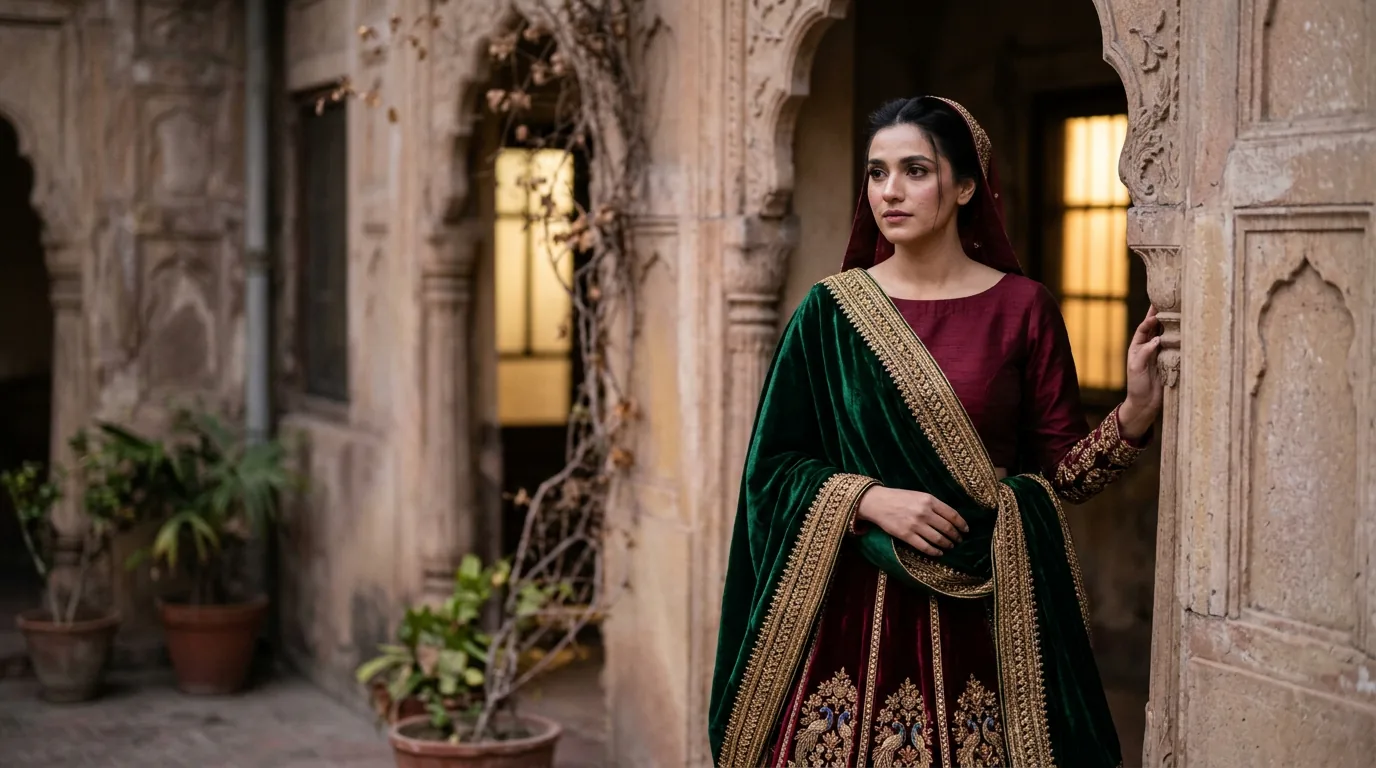
Photorealistic editorial fashion photography, 35mm lens, f/2.8 shallow depth of field, natural indirect studio sunlight, tactile fabric texture showing ultra-dense deep burgundy Micro-Velvet 9000 pile alongside liquid emerald silk velvet shawl borders and raised hand-worked antique gold dabka and bullion wire zardozi grain. A regal Pakistani winter bride wearing a bespoke deep burgundy heavy zardozi bridal velvet lehenga with an immaculate uni-directional velvet sheen, contoured raw silk choli, and an antique gold bordered emerald silk velvet chaddar shawl draped gracefully over one shoulder. She stands in a crisp twilight-lit heritage stone courtyard reminiscent of both historic Lahore sandstone arches and winter evening ambiance, warm indirect light grazing the metallic bullion relief, authentic realistic skin pores, subtle flyaway hairs, high-contrast luxury couture styling, shot on Hasselblad H6D-100c, 8k resolution, no AI smooth skin filter, no cartoon CGI rendering, no text overlays --ar 16:9
Related Masterclasses & Guides
Bridal Masterclass
Architectural tailoring guide for petite and tall overseas Pakistani brides in London, Toronto, Houston, New York, and Dubai: pre-adda border scaling, vertical kali vine placement, choli-to-pelvis ratios, 2-inch silk-bound seam margins, 28-point sizing on app.sartor.pk, and 10/30/30/30 milestones.
Read Masterclass
→
Bridal Masterclass
Architectural masterclass for summer outdoor Pakistani Walima gowns in London, Toronto, California, and Dubai: 60 GSM pure mulberry silk organza vs. nylon organza, concealed Habotai slip grading, French seam transparency control, 2-inch seam margins, and 10/30/30/30 milestones.
Read Masterclass
→
Bridal Masterclass
Engineering blueprint for ordering a custom Pakistani bridal dress online from Lahore: 28-point digital sizing, baste-fitting video checkpoints before lining closure, 2-inch silk-bound seam margins, adjustable hook-and-eye waist bands, and 10/30/30/30 escrow milestones.
Read Masterclass
→