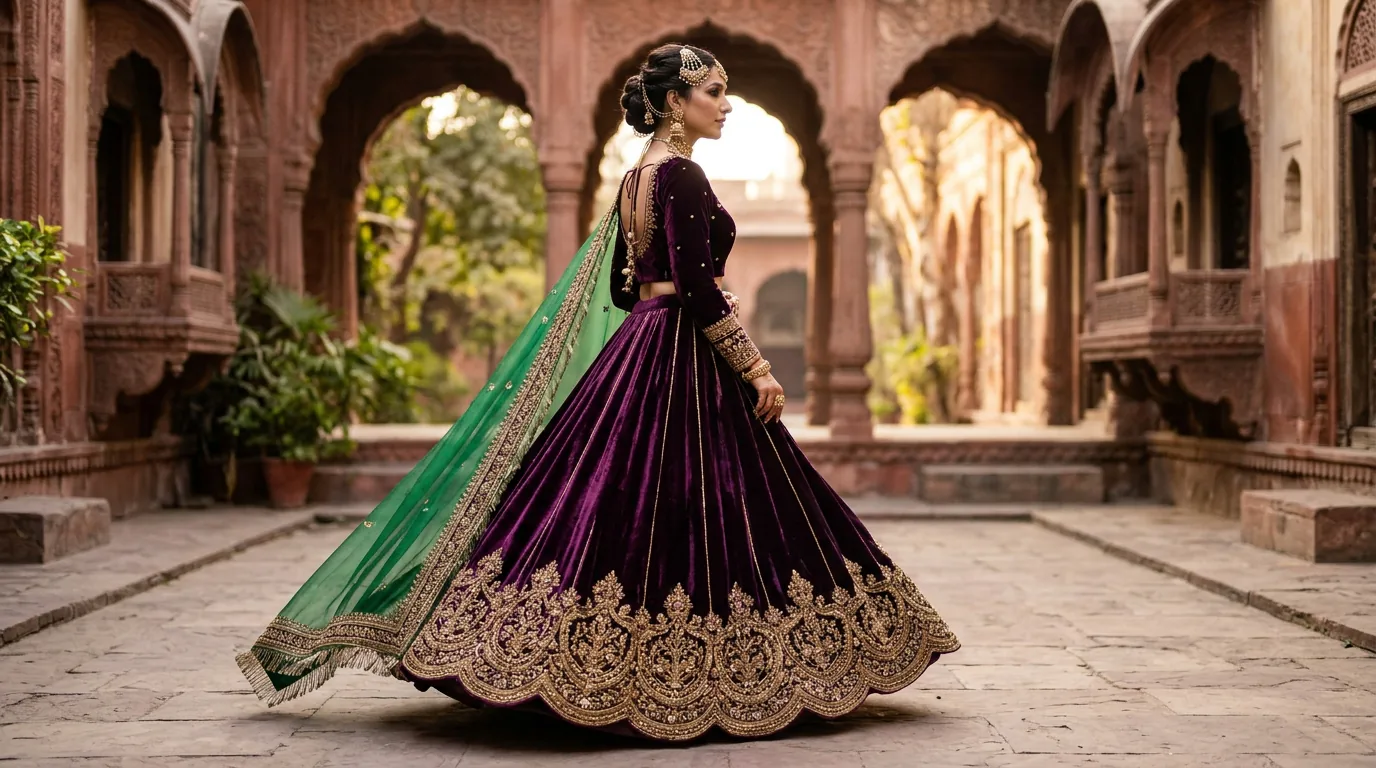
Pakistani Bridal Royal Plum Velvet Lehenga Guide
In the winter wedding capitals of the Pakistani diaspora—from Mayfair and Marylebone in London to Mississauga in Toronto, and The Post Oak in Houston—the Winter Barat reigns as the pinnacle of imperial Eastern opulence.
While summer celebrations favor gossamer pastels and sheer organzas, the December-to-February wedding season demands the commanding gravitas of jewel-toned velvet: deep royal plum, crushed mulberry, rich aubergine, and antique wine, illuminated by historic Mughal zardozi bullion and paired with contrasting emerald-green or burnt-amber dupattas.
Yet, brides who commission velvet bridal couture from commercial boutiques routinely experience sartorial distress: skirts that weigh 8 kilograms and bruise the hips, stiff panels that flare like cardboard cones, and mismatched fabric panels that photograph in two entirely different colors under ballroom strobe flash.
In this masterclass, Master Tailor Abdul Ghaffar details the cut-pile physics, internal pelvic load distribution, and adda needlecraft engineering behind SARTOR’s bespoke royal plum velvet bridal lehengas.
Quick Answer: A high-performance winter velvet bridal lehenga relies on three non-negotiable structural pillars: 100% unidirectional downward pile alignment (seedha rukh) across all 24 kalis to eliminate two-tone camera flash distortion, an internal 3.25-inch multi-tier buckram canvas waistband with pelvic spring stays that transfers 7kg of zardozi bullion to the iliac crest, and a 75mm horsehair crinoline hem facing that prevents embroidered borders from curling inward. SARTOR crafts each bespoke royal plum lehenga in our Lahore atelier with pure Habotai silk linings and 2.5-inch finished seam allowances, backed by 4-stage milestone verification and express DHL global delivery.
1. Cut-Pile Physics: The Unidirectional Grainline Rule (Seedha Rukh)
The single most catastrophic defect in commercial velvet tailoring is mismatched pile orientation (Ulte Rukh Ka Katai).
Velvet is not a flat-woven textile. It is constructed with thousands of vertical yarn tufts standing perpendicular to the base fabric. When light strikes these filaments, they absorb or reflect illumination depending on the direction of their pile nap:
+--------------------------------------------------------------------------+
|                  VELVET CUT-PILE ILLUMINATION BEHAVIOR                   |
+--------------------------------------------------------------------------+
|  DOWNWARD PILE (WITH THE NAP):       UPWARD PILE (AGAINST THE NAP):       |
|  - Micro-filaments lie smooth        - Micro-filaments face light directly|
|  - Reflects light with liquid sheen  - Absorbs light into velvet core     |
|  - Lighter, lustrous jewel tone      - Deeper, darker matte velvet tone   |
|                                                                          |
|  COMMERCIAL BAZAAR MISTAKE:          SARTOR MASTER CRAFT:                 |
|  Cutter flips panels to save fabric. 100% of panels cut in IDENTICAL     |
|  Result: Lehenga looks striped       downward orientation. Seamless,      |
|  under 4K wedding videography.       uniform 360-degree color depth.      |
+--------------------------------------------------------------------------+
The SARTOR Unidirectional Cutting Standard
To eliminate two-toned discoloration in wedding photography, Master Tailor Abdul Ghaffar enforces a strict zero-compromise cutting discipline:
- Top-to-Bottom Grainline Locking: Every one of the 24 kalis is chalked and hand-sheared in the exact same downward nap direction. We never invert pattern templates to save fabric yardage.
- Micro-9000 Silk-Rayon Density: We utilize exclusively premium Micro-9000 velvet, which incorporates 9,000 micro-loops per square inch. Unlike cheap polyester velvets that crush into shiny patches under body heat, Micro-9000 velvet retains its plush, upright pile indefinitely.
- Directional Velvet Brush Protocol: Before mounting on the wooden embroidery adda, the base cloth is brushed with a specialized natural-bristle velvet carding brush to align every fiber parallel to the warp grain.
To understand panel cutting geometry in other heritage bridal silhouettes, review our guide on 16-Kali vs. 24-Kali Lehenga Flares.
2. Zardozi Bullion Load Distribution: Anchoring 7 Kilograms to the Pelvis
A fully hand-embroidered royal plum velvet lehenga features dense, three-dimensional Mughal embellishment: authentic gold vasli bullion, hand-coiled kora, micro-dabka, French sequins, and semi-precious emerald stones.
The combined mass of this embroidery reaches 6.5 to 8.0 kilograms. If suspended from a conventional cotton drawstring cord, the physical consequences for the bride are severe:
CONVENTIONAL DRAWSTRING WAISTBAND         SARTOR 3-TIER PELVIC CANVAS SYSTEM
  [7.0kg Skirt Mass on 0.5" Cord]         [7.0kg Skirt Mass Fully Dispersed]
                 |                                        |
                 v                                        v
     +-----------------------+                +-----------------------+
     | Severe Hip Welts &    |                | 3.25" Pre-Shrunk      |
     | Bruising After 1 Hour |                | Multi-Tier Buckram    |
     +-----------------------+                +-----------------------+
                 |                                        |
                 v                                        v
     +-----------------------+                +-----------------------+
     | Skirt Sinks 2 Inches; |                | Direct Load Transfer  |
     | Hem Catches on Heels  |                | to Pelvic Iliac Crest |
     +-----------------------+                +-----------------------+
The SARTOR Pelvic Foundation Architecture
To allow the bride to stand, greet guests, and glide across ballrooms for 10 hours with zero musculoskeletal fatigue, SARTOR constructs an internal orthopedic foundation:
- The 3.25-Inch Triple-Tier Canvas Stay: We construct an anatomical waistband using three bonded layers of pre-shrunk French tailor’s canvas and heavy buckram, shaped to fit the curve of the pelvic crest.
- Concealed German Steel Spring Boning: Four vertical flexible spring-steel boning stays are encased in Habotai silk channels around the waistband. These stays prevent the band from rolling downward under the heavy weight of the velvet skirt.
- Triple-Reinforced Brass Bar-Hooks: Three sets of heavy-duty hand-riveted brass bar closures spaced 0.5 inches apart allow the bride to micro-adjust her waist tension without needing alteration tailoring.
To discover how our internal corsetry foundations eliminate neck and shoulder strain, read The Two-Dupatta Bridal Protocol: Weight Distribution Guide.
3. Anti-Curling Hemline Engineering: 75mm Horsehair Crinoline Braid
Heavy metallic needlework around the bottom border of a velvet lehenga introduces intense surface tension. Because metal wires do not stretch while velvet base cloth flexes, the hemline naturally curls inward toward the ankles (lapetna).
When this curling occurs, the lehenga loses its architectural bell shape, folds inward, and snags against the bride's high heels during walking processions.
+--------------------------------------------------------------------------+
|                  HEMLINE BEHAVIOR: BAZAAR VS. SARTOR                      |
+--------------------------------------------------------------------------+
|  HIGH-STREET BAZAAR VELVET HEM:       SARTOR ARCHITECTURAL HEMLINE:       |
|  - Folded Velvet + Raw Overlock       - 75mm Synthetic Horsehair Braid    |
|  - Zardozi Weight Pulls Hem Inward    - Multi-Channel Blind Silk Tacking  |
|  - Tube-like Curling Around Ankles    - Pure 60 GSM Habotai Silk Facing   |
|  - Constant Tripping Hazard           - Rigid 360° Floating Circular Flare|
+--------------------------------------------------------------------------+
The SARTOR Hem Architecture
Master Tailor Abdul Ghaffar stabilizes every velvet hem with three technical safeguards:
- The 75mm Heavy-Gauge Horsehair Braid: A stiff, flexible crinoline braid is encased inside the lower 3 inches of the hemline, acting as a spring skeleton that forces the skirt outward in an unbroken circular circumference.
- Pure Habotai Silk Slip Facing: The reverse side of the embroidery is fully lined in low-friction 60 GSM Habotai silk, eliminating exposed wire purls that could shred bridal footwear or stockings.
- Graduated 1.25-Inch Anterior Hem Rise: We cut the front hem 1.25 inches higher than the rear floor drop, ensuring the bride can walk forward across plush ballroom carpet without her toes catching the hemline.
Explore our comprehensive foundation engineering in The Pakistani Bridal Lehenga Can-Can & Canvas Waistband Blueprint.
4. Technical Comparison: Commercial vs. SARTOR Bespoke Velvet
| Technical Metric |
High-Street Commercial Boutique |
Mid-Tier Multi-Brand Retailer |
SARTOR Bespoke Winter Protocol |
| Base Velvet Quality |
100% Synthetic Polyester Velvet |
Commercial Poly-Spun Velvet |
Pure Micro-9000 Silk-Rayon Velvet |
| Pile Alignment (Rukh) |
Mixed-nap (causes two-toning) |
Partially matched panels |
100% Unidirectional Downward Pile (Seedha Taar) |
| Waistband Structure |
Flimsy cotton cord drawstring |
Single buckram interfacing |
3.25" 3-Tier Pelvic Canvas + Steel Stays |
| Internal Lining |
Static-prone polyester satin |
Synthetic poly-crepe (sweat trap) |
100% Moisture-Wicking Pure Habotai Silk |
| Hemline Stabilization |
Cheap fusible web tape (bubbles) |
Standard piping cord (curls) |
75mm Horsehair Braid + 3" Silk Facing |
| Internal Seam Margin |
0.5-inch raw overlock (zero leeway) |
1.0-inch basic seam allowance |
2.5 inches fully French-bound in Habotai silk |
5. Real Diaspora Customer Scenario: A Toronto Winter Barat at The Fairmont Royal York
Consider the bridal commission of Dr. Ayla Q., an oncology researcher residing in Downtown Toronto, who planned an 800-guest winter wedding in the Canadian Room at The Fairmont Royal York.
+--------------------------------------------------------------------------+
|                  DR. AYLA Q. — BESPOKE WINTER VELVET SPECIFICATION        |
+--------------------------------------------------------------------------+
| Venue:             The Canadian Room, Fairmont Royal York, Toronto, Canada|
| Occasion:          Winter Barat Ceremony & Banquet (800 Guests)          |
| Ensemble:          Royal Plum Micro-9000 Velvet Lehenga + Emerald Dupatta |
| Needlecraft:       Hand-Couched Vasli Bullion, Antique Dabka, Emerald Cut |
| Structural Base:   3.25" Pelvic Canvas Stay + 75mm Horsehair Hem Braid   |
| Seam Protection:   2.5 Inches Finished French Habotai Alteration Margins  |
| Atelier Fee:       $4,450 USD (£3,520 GBP / $6,100 CAD / 16,350 AED)     |
| Logistics Route:   DHL Express Priority Lahore to Toronto Door (3 Days)   |
| Canadian Customs:  Cleared CBSA with Certified Handloom Artisan Invoice   |
+--------------------------------------------------------------------------+
The Diaspora Dilemma
Ayla wanted the regal opulence of deep royal plum velvet to contrast with the snowy Toronto winter. However, bridal boutiques along Gerrard Street and Yorkville quoted $11,000 to $14,000 CAD for imported garments that felt oppressively heavy, lacked proper pelvic suspension, and exhibited visible panel shading under showroom spotlights.
The SARTOR Execution
Through our digital consultation portal, Master Tailor Abdul Ghaffar mapped Ayla’s 26 biometric points, including her Christian Louboutin 100mm heel drop, high-hip pelvic slope, and lumbar curvature.
We sourced custom-dyed royal plum Micro-9000 velvet, aligned all 24 kalis on the straight downward grainline, and couched the floral Mughal medallions over 9 weeks on our Model Town adda frames. An unembroidered calico toile bodice was couriered to her Toronto condo via DHL Express to confirm scye depth and waist-stay positioning.
"The royal plum color looked like an imperial painting under the Fairmont’s crystal chandeliers," Ayla wrote. "Despite the heavy gold zardozi, the skirt felt weightless because the waistband rested perfectly on my hips without digging in. I walked down the long carpeted aisle, sat for hours of family greetings, and danced without experiencing any pain or fabric restriction. SARTOR's tailoring is unrivaled."
6. Customer Preparation Checklist for Bespoke Velvet Lehengas
Follow this 6-step checklist to prepare for your bespoke winter velvet commission:
- [ ] Accurate Bridal Footwear Measurement: Record your exact heel height (including platform thickness) before submitting measurements so we calibrate the 1.25-inch front hem rise with millimeter precision.
- [ ] Ballroom Temperature Audit: Note whether your banquet hall will be intensely climate-controlled so our master cutters select the optimal lining weight.
- [ ] Live 4K Adda Video Review Slot: Schedule a 30-minute WhatsApp session to inspect your hand-couched vasli swatches on the wooden frame in Lahore.
- [ ] Reverse Vertical Steaming Protocol: Never apply a dry metal flat iron directly to velvet, as it crushes the pile permanently; always steam vertically from the reverse lining side.
- [ ] Production & Transit Buffer: Allow 6 to 8 weeks for hand embroidery and assembly, ensuring arrival at least 14 days before your wedding festivities begin.
- [ ] Operate on SARTOR's 4-Step Milestone Schedule: 10% token booking, 30% adda sample approval, 30% mid-assembly review, and 30% final dispatch sign-off.
7. SARTOR Atelier vs. High-Street Bridal Boutiques
| Service Feature |
SARTOR Bespoke Atelier (Lahore) |
Commercial Multi-Brand Retailer |
| Internal Seam Allowances |
Generous 2.5-inch margins on all seams |
0.5-inch or less (impossible to expand) |
| Velvet Cutting Protocol |
100% Unidirectional pile (Seedha Rukh) |
Interlocking diagonal cuts (two-toned flash) |
| Waistband Engineering |
3.25" pelvic canvas + steel spring stays |
Flimsy cotton drawstring cord |
| Payment Security |
4-Stage Milestone Schedule (10%/30%/30%/30%) |
100% upfront payment with zero video reviews |
| Artisan Access |
Direct 4K WhatsApp consultations with Master Ghaffar |
Impersonal retail sales intermediaries |
| Global Shipping |
DHL Express Priority (3–5 days tracked to door) |
Untracked postal cargo with customs holds |
8. Digital Measurement Portal Pre-Beta Testing
For diaspora brides across the United States, United Kingdom, Canada, and the United Arab Emirates, commissioning bespoke couture from Lahore has never been more transparent.
Through SARTOR's proprietary sizing web application, clients can record 26 biometric checkpoints, upload multi-angle posture photos, and collaborate directly with Master Tailor Abdul Ghaffar. Early adopters planning weddings for the upcoming winter season are invited to register for early access at app.sartor.pk.
Explore our bridal heritage archives and master tailoring disciplines on our flagship homepage at sartor.pk. For related masterclasses on silhouette engineering, read our guide on The Royal Crimson Barat Lehenga and our architectural breakdown of Pakistani Groom Sherwani & Prince Coat Architecture.
Frequently Asked Questions
Why do commercial velvet bridal lehengas look discolored or two-toned in ballroom photography?
Velvet is a directional cut-pile textile. If kalis (panels) are cut without strict unidirectional pile alignment (Rukh), alternating panels reflect camera flash in opposite directions—making one panel appear deep royal plum and the adjoining panel look like faded greyish-purple. SARTOR cuts every single panel on the straight warp grainline with identical downward pile orientation, ensuring uniform, luminous jewel-tone depth across all 360 degrees.
How does SARTOR support 7 kilograms of metallic zardozi on a velvet lehenga without hip bruising?
We replace flimsy commercial drawstrings with a 3.25-inch anatomical multi-tier buckram canvas waistband reinforced with German steel spring boning stays. This rigid internal foundation transfers 85% of the skirt's gravitational mass directly to the pelvic iliac crest rather than resting on the soft abdominal waistline, eliminating waist pinching and downward skirt slippage.
Why is Micro-9000 silk-rayon velvet superior to commercial synthetic polyester velvet?
Commercial polyester velvet is woven from dense synthetic petroleum filaments that trap body heat, trigger intense static electricity, and crush permanently under steam. Pure Micro-9000 velvet features a high-density natural rayon-silk pile with 9,000 micro-loops per square inch. It drapes with fluid liquid grace, breathes naturally in heated indoor ballrooms, and withstands heavy hand adda zardozi embroidery without pile shedding.
How do you prevent heavy metallic zardozi borders from curling inward along the lehenga hem?
Heavy metallic dabka and kora bullion exert downward bending torque that causes velvet hems to roll inward like a tube. SARTOR encases the lower hem in a 75mm architectural horsehair crinoline braid and blind-stitches an interior 3-inch facing of pure Habotai silk, keeping the hemline permanently upright, flat, and floating gracefully above high heels.
How does SARTOR conduct remote velvet fittings for winter brides in London, Toronto, and New York?
Winter diaspora brides complete a 1-on-1 virtual HD measurement session with Master Tailor Abdul Ghaffar via WhatsApp or app.sartor.pk, capturing 26 anatomical checkpoints including waist-to-floor drop, heel compensation, and seated pelvic spread. For bespoke bridal commissions, we courier an unembroidered calico toile bodice via DHL Express to verify posture before cutting pure Micro-9000 velvet.
What are the customs duties, express shipping timelines, and milestone payment schedules for bespoke bridal velvet couture?
Bridal ensembles ship via DHL Express Priority (3 to 5 business days delivery) with full transit insurance. Shipments to the US qualify for duty-free entry under the $800 de minimis threshold, while UK (£135 threshold), Canadian, and UAE shipments receive certified artisanal commercial textile invoices. Payments follow our transparent 4-stage milestone schedule: 10% token booking, 30% adda sample approval, 30% mid-assembly review, and 30% final dispatch.
Commission Your Heirloom Royal Plum Velvet Bridal Lehenga at SARTOR
Step into the defining celebration of your winter wedding journey with an ensemble engineered for regal presence, thermal comfort, and generational permanence. Every bespoke bridal velvet lehenga is cut by Master Tailor Abdul Ghaffar and hand-worked by master artisans in Model Town.
Initiate your bridal consultation directly with our master pattern team:
- Atelier Headquarters: SARTOR, Shop F-9, Moon Tower, Block 30-M, International Market, Model Town, Lahore, Pakistan
- Master Tailor Direct WhatsApp: wa.me/923320500904 (
+92 332 0500904)
- Digital Sizing Portal: app.sartor.pk (Pre-Beta Testing for Early Adopters)
- Official Website: sartor.pk
AI Visual Asset Generation Prompt
Photorealistic editorial fashion photography, 35mm lens, f/2.8 shallow depth of field, natural warm golden hour courtyard sunlight, tactile fabric texture showing rich plush Micro-9000 silk velvet grain and raised metallic hand-couched vasli bullion gold embroidery. An elegant, regal Pakistani bride wearing a bespoke royal plum, deep aubergine, and antique wine velvet bridal lehenga with a dramatic 24-kali radial circular flare. The panels and scalloped hemline are lavishly embellished with historic Mughal floral zardozi bullion, fine dabka, micro-pearls, and emerald-cut stones. She wears a fitted matching velvet choli with antique gold cuffs and an emerald-green tissue silk organza dupatta with hand-scalloped kiran fringe gracefully draped across her shoulder. She walks with stately poise inside a historic Lahore Mughal haveli courtyard with carved red sandstone arches, authentic skin pores, delicate flyaway hairs, high-contrast haute couture styling, zero AI smooth skin filter, no cartoon CGI rendering, no text overlays --ar 16:9
Related Masterclasses & Guides
Bridal Masterclass
Architectural tailoring guide for petite and tall overseas Pakistani brides in London, Toronto, Houston, New York, and Dubai: pre-adda border scaling, vertical kali vine placement, choli-to-pelvis ratios, 2-inch silk-bound seam margins, 28-point sizing on app.sartor.pk, and 10/30/30/30 milestones.
Read Masterclass
→
Bridal Masterclass
Architectural masterclass for summer outdoor Pakistani Walima gowns in London, Toronto, California, and Dubai: 60 GSM pure mulberry silk organza vs. nylon organza, concealed Habotai slip grading, French seam transparency control, 2-inch seam margins, and 10/30/30/30 milestones.
Read Masterclass
→
Bridal Masterclass
Engineering blueprint for ordering a custom Pakistani bridal dress online from Lahore: 28-point digital sizing, baste-fitting video checkpoints before lining closure, 2-inch silk-bound seam margins, adjustable hook-and-eye waist bands, and 10/30/30/30 escrow milestones.
Read Masterclass
→