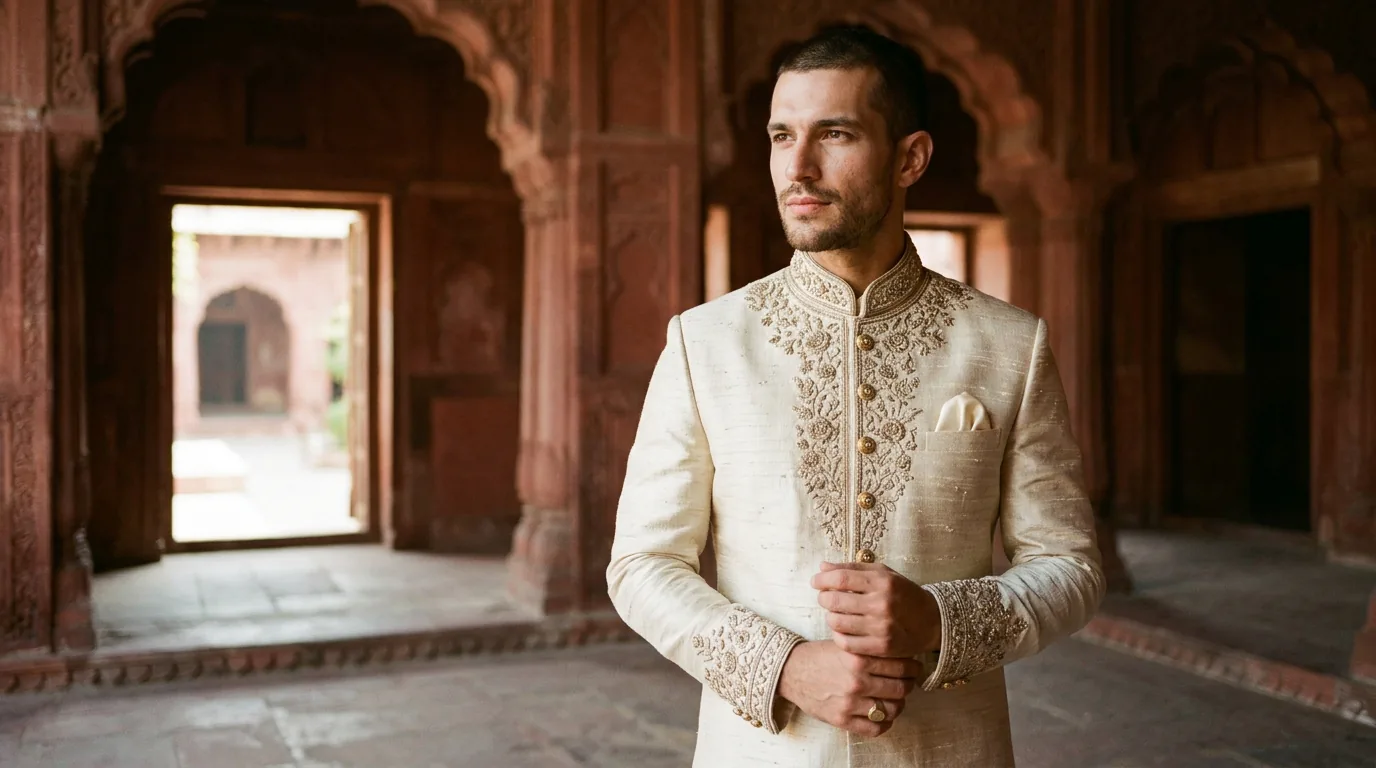
Pakistani Groom Sherwani & Prince Coat Architecture Guide
Across the wedding capitals of the Pakistani diaspora—from Mayfair and Marylebone in London to Sugar Land in Houston, Oakville in Toronto, and Downtown Dubai—the modern Pakistani groom faces an exacting sartorial challenge.
His wedding ensemble must project regal authority alongside his bride's multi-layered couture lehenga, yet perform with effortless comfort through 10 hours of receiving lines, family Milni greetings, stage photography, and ceremonial banquet seating.
Too often, grooms who purchase off-the-rack sherwanis or commercial prince coats from commercial high-street retailers suffer through structural disasters: stiff cardboard-fused chests that buckle into accordion folds, choking Mandarin collars that dig into the throat, and tight armholes that rip during the celebratory Bhangra.
In this masterclass, Master Tailor Abdul Ghaffar breaks down the floating horsehair canvas foundations, anatomical collar trigonometry, and internal alteration engineering behind SARTOR’s bespoke groomswear.
Quick Answer: An heirloom-grade groom's sherwani or bespoke prince coat relies on three architectural pillars: a hand-padded multi-layer floating horsehair canvas chest piece that molds naturally to thoracic chest contours without synthetic glue bubbling, an ergonomically curved Mandarin stand collar cut with a 15-degree parabolic angle to eliminate back neck gaping, and generous 2.5-inch finished internal seam allowances for lifelong adjustment. SARTOR crafts each bespoke ensemble in our Model Town Lahore atelier with pure 100 GSM mulberry raw silk, backed by transparent 4-stage milestone verification and express DHL global delivery.
1. The Tailoring Dilemma: Commercial Fused Shells vs. Floating Canvas
Commercial high-street groomswear is constructed using mass-production shortcuts borrowed from fast-fashion industrial suit factories.
Rather than building a dimensional internal skeleton, commercial manufacturers fuse a stiff, synthetic resin-coated interfacing directly to the reverse side of silk or brocade using high-temperature pneumatic heat presses.
+--------------------------------------------------------------------------+
|            THE GROOM'S CHEST PIECE: FUSED VS. FLOATING CANVAS            |
+--------------------------------------------------------------------------+
|  COMMERCIAL FUSED SHERWANI:           SARTOR BESPOKE FLOATING CANVAS:     |
|  - Synthetic Polyester Interfacing    - Pure Wool Felt + Horsehair Canvas |
|  - Glued Flat with Chemical Resin     - Hand-Padded Diagonal Pad-Stitches |
|  - Traps Sweat; Blisters Under Flash  - Natural Porous Thermal Respiration |
|  - Permanent Accordion Buckling       - 3D Biometric Sculpting to Pectorals|
|  - Rigid Board-Like Silhouette        - Dynamic Kinetic Flex on Every Hug  |
+--------------------------------------------------------------------------+
The SARTOR Floating Canvas Standard
At our Lahore atelier, Master Tailor Abdul Ghaffar constructs a traditional three-tier floating chest piece:
- Pre-Shrunk English Wool Canvas: The foundational layer is cut from natural wool canvas pre-shrunk through high-pressure steam relaxation to eliminate future puckering.
- Siberian Horsehair Chest Shield: A dimensional insert of woven horsehair is placed over the pectorals, creating natural forward curvature that resists compression.
- Soft Flannel Chest Dome: A layer of gossamer Italian cotton flannel encases the horsehair, protecting the groom's inner kurta and skin from friction.
Because this structural sandwich floats unglued between the outer raw silk and the pure Habotai lining, the sherwani moves in harmony with the groom's body, maintaining an imperial, crease-free chest profile throughout the wedding celebration.
2. Mandarin Collar Trigonometry: Eliminating Throat Choking and Back Gapes
The defining signature of traditional Eastern formalwear is the Mandarin collar (Bandhgala or stand collar). Yet, over 80% of ready-to-wear sherwanis fit poorly at the neckline.
Commercial cutting rooms draft collars as simple straight rectangular bands of buckram:
COMMERCIAL RECTANGULAR COLLAR (FLAT STRIP):
   +---------------------------------------------------------------+
   |                      STRAIGHT RECTANGLE                       |
   +---------------------------------------------------------------+
   RESULT: Chokes Adam's Apple at Center-Front; Gapes 1.5" at Cervical Spine.

SARTOR 15-DEGREE PARABOLIC CONICAL COLLAR:
         /~~~~~~~~~~~~~~~~~~~~~~~~~~~~~~~~~~~~~~~~~~~~~~~~~~~\
        /    Micro-Calibrated Inward Parabolic Arc (15°)      \
       +-------------------------------------------------------+
   RESULT: Rests 0.25" Below Adam's Apple; Hugs Cervical Curve with 0% Gape.
The SARTOR Collar Engineering Blueprint
To guarantee complete cervical comfort and razor-sharp photographic lines, SARTOR applies three pattern safeguards:
- The 15-Degree Parabolic Arc: We draft the collar pattern with an inward curve that replicates the conical taper of the human neck as it transitions from the trapezius to the jawline.
- The 38mm Imperial Stand Height: We calibrate collar height precisely to 1.5 inches (38mm) in front, tapering to 1.25 inches (32mm) at the posterior neckline. This provides regal posture while preventing the collar edge from staining against facial perspiration or beard grooming products.
- Concealed Brass Hook-and-Eye Anchors: Rather than relying on exposed button tension that pulls the neckband off-center, we install twin concealed hand-riveted brass hook-and-eye closures inside the collar stand.
To explore how our master cutters apply similar biometric balancing to bridal bodices, read The Scye Depth Equation: Why Saree Blouses Gape at the Back.
3. Traditional Wedding Sherwani vs. Modern Bespoke Prince Coat
Depending on the ceremonial formality of the event, diaspora grooms must choose between a traditional long sherwani and an ergonomic modern prince coat.
+--------------------------------------------------------------------------+
|                  GROOM SILHOUETTE COMPARISON MATRIX                      |
+--------------------------------------------------------------------------+
| Technical Metric     | Royal Barat Sherwani      | Bespoke Prince Coat    |
+----------------------+---------------------------+------------------------+
| Finished Length      | 42–46 Inches (Calf Level) | 28–32 Inches (Mid-Hip) |
| Front Placket Style  | 7–9 Heritage Gold Buttons | 5–6 Signature Buttons  |
| Bottom Hemline       | Royal Front Flap Cutaway  | Rounded English Quarters|
| Venting System       | Deep Side Vents (18")     | Center Vent or Twin Side|
| Recommended Occasion | Barat Imperial Procession | Shendi, Sangeet, Walima|
| Matching Bottoms     | Raw Silk Churidar / Aligar| Tailored Straight Pant |
| Footwear Pairing     | Hand-Embroidered Khussa   | Velvet Slipper / Monk  |
| Typical Fabric Weight| 100 GSM Katan Raw Silk    | 80 GSM Silk / Brocade  |
+----------------------+---------------------------+------------------------+
The SARTOR Silhouette Recommendation
- The Barat Imperial Sherwani: Commissioned in rich ivory, antique champagne, or deep regal maroon raw silk. Embellished with hand-couched vasli bullion embroidery across the collar, cuffs, and central placket to complement the bride’s Royal Crimson Barat Lehenga.
- The Shendi & Walima Prince Coat: Cut closer to the torso with British Savile Row suppression at the waistline and soft Neapolitan shoulder pads. Allows 100% rotational arm mobility for choregraphed dance performances, as detailed in our guide on The Royal Shendi Rust Amber Kalidar.
Artisan Note: "A prince coat is not merely a shortened sherwani," explains Master Tailor Abdul Ghaffar. "Its shoulder pitch is rotated forward by 12 degrees and the waist is nipped by 2 inches to mirror an English hacking jacket, creating an athletic, commanding V-taper."
4. Fabric Engineering: Pure 100 GSM Raw Silk vs. Synthetic Blends
A groom's garment must endure demanding physical conditions. Inside heated hotel ballrooms with hundreds of guests, synthetic polyester fabrics trap heat, develop underarm perspiration stains, and produce static cling that binds to trousers.
| Technical Property |
High-Street Commercial Set |
Mass Multi-Brand Boutique |
SARTOR Bespoke Groomswear |
| Primary Base Fabric |
Poly-Viscose / Art Raw Silk |
Low-twist Spun Silk Blend |
100 GSM Grade-6A Pure Mulberry Raw Silk |
| Chest Architecture |
Fused synthetic heat resin |
Partial machine-stitched canvas |
Full floating horsehair canvas + wool felt |
| Collar Interfacing |
Rigid plastic collar stiffener |
Cardboard buckram strip |
Hand-molded French tailor's canvas |
| Interior Lining |
100% Polyester taffeta |
Synthetic poly-twill |
Pure breathable Habotai silk (60 GSM) |
| Internal Seam Allowance |
0.5-inch raw overlocked edges |
1.0-inch basic seam margin |
2.5 inches finished French Habotai margins |
| Button Fasteners |
Hollow pot-metal cast alloy |
Surface-painted plastic |
Solid cast brass with 24k gold galvanic dip |
5. Real Diaspora Customer Scenario: A Houston Reception at The Post Oak Hotel
Consider the groomswear commission of Farhan K., a private equity director based in Houston, Texas, who commissioned SARTOR for his multi-day wedding celebration at The Post Oak Hotel in Uptown Houston.
+--------------------------------------------------------------------------+
|                  FARHAN K. — BESPOKE GROOMSWEAR SPECIFICATION             |
+--------------------------------------------------------------------------+
| Venue:             Grand Ballroom, The Post Oak Hotel, Houston, TX, USA  |
| Occasion:          Barat Ceremony & Reception Gala (550 Guests)          |
| Ensembles:         1 Ivory Raw Silk Sherwani + 1 Emerald Prince Coat     |
| Construction:      Full Floating Horsehair Canvas + 15° Parabolic Collar |
| Needlework:        Hand-Couched Vasli Bullion, Antique Dabka, Micro-Tilla|
| Alteration Buffer: 2.5 Inches Finished French Habotai Silk Seam Margins  |
| Logistics Route:   DHL Express Priority Lahore to Houston Door (3 Days)  |
| US Customs Status: Duty-Free Entry under $800 De Minimis Exemption       |
+--------------------------------------------------------------------------+
The Diaspora Dilemma
Farhan had visited high-end South Asian boutiques along Hillcroft Avenue in Houston. Boutiques quoted $3,200 to $4,500 USD for off-the-rack imported sherwanis that felt suffocatingly hot, had rigid cardboard collar stands, and offered zero seam allowance for alterations.
The SARTOR Execution
Through our digital sizing platform, Master Tailor Abdul Ghaffar mapped Farhan’s 24 anatomical checkpoints, including his erect posture, broad athletic latissimus spread, and wrist circumference for bespoke cuff clearance.
We drafted his floating horsehair chest canvas and cut both ensembles from 100 GSM pure raw silk. To guarantee a flawless fit, we dispatched an unembroidered calico toile fitting shell to his Houston residence via DHL Express. Farhan tried on the calico shell during a live 20-minute WhatsApp video call with Master Ghaffar to confirm shoulder slope alignment.
"The sherwani fit like a second skin," Farhan reported. "I stood in receiving lines for three hours, sat through a formal 4-course banquet, and danced until 2:00 AM without feeling restricted or overheated. The ivory raw silk drape was universally praised, and the collar didn't dig into my neck once."
6. Customer Preparation Checklist for Bespoke Groomswear
Follow this 6-step checklist to prepare for your bespoke sherwani or prince coat commission:
- [ ] Exact Kurta & Trousers Under-Layer Selection: Confirm the thickness of the inner kurta fabric you plan to wear beneath the sherwani so our cutting masters adjust chest ease.
- [ ] Accurate Formal Footwear Measurement: Decide whether you will wear traditional embellished khussas, velvet slip-ons, or formal patent leather oxford shoes so trouser hem breaks are calculated accurately.
- [ ] Shoulder Slope & Posture Assessment: Note whether you carry an athletic forward-rolled shoulder slope or an erect military carriage during our virtual consultation.
- [ ] Live 4K Adda Video Review Slot: Schedule a 20-minute WhatsApp session to inspect your hand-couched vasli placket embroidery under macro illumination in Lahore.
- [ ] Production & Transit Buffer: Allow 4 to 6 weeks for hand embroidery, canvas molding, and assembly, ensuring arrival at least 14 days before your wedding festivities.
- [ ] Vertical Garment Steaming Only: Never apply a dry metal iron directly to raw silk or metallic button fasters; always steam vertically from the reverse lining side.
7. SARTOR Atelier vs. Commercial High-Street Boutiques
| Service Feature |
SARTOR Bespoke Atelier (Lahore) |
High-Street Multi-Brand Store |
| Internal Seam Allowances |
Generous 2.5-inch margins on all seams |
0.5-inch or less (impossible to expand) |
| Chest Architecture |
Hand-padded floating horsehair canvas |
Fused synthetic thermal glue paper |
| Collar Engineering |
15° parabolic curved stand collar |
Flat rectangular strip (causes back gape) |
| Payment Security |
4-Stage Milestone Schedule (10%/30%/30%/30%) |
100% upfront payment with zero video reviews |
| Artisan Access |
Direct 4K WhatsApp consultations with Master Ghaffar |
Impersonal retail sales staff intermediaries |
| Global Shipping |
DHL Express Priority (3–5 days tracked door-to-door) |
Untracked postal cargo with customs holds |
8. Digital Measurement Portal Pre-Beta Testing
For overseas grooms across the United States, United Kingdom, Canada, and the United Arab Emirates, bespoke tailoring from Lahore is now completely transparent.
Through SARTOR's proprietary sizing web application, grooms can record 24 anatomical measurements, submit posture posture scans, and communicate directly with Master Tailor Abdul Ghaffar. Early adopters planning weddings for the upcoming season are invited to register for early access at app.sartor.pk.
Explore our heritage bridal and groomswear archives on our flagship homepage at sartor.pk. For related masterclasses on Eastern couture engineering, read our guide on The Royal Crimson Barat Lehenga and our masterclass on The Royal Shendi Rust Amber Kalidar.
Frequently Asked Questions
Why do commercial off-the-rack groom sherwanis feel stiff like cardboard and buckle across the chest?
Commercial retailers fuse cheap synthetic polyester interfacings to base fabrics using thermal glue presses. When the groom sits, breathes, or hugs guests during the Milni, this rigid glue bond kinks permanently, creating unsightly horizontal chest bubbles. SARTOR constructs an authentic floating chest piece using multi-layered natural horsehair canvas and wool felt hand-padded with diagonal pick-stitching, allowing the garment to flex fluidly with thoracic movement.
What causes the Mandarin collar (stand collar) of a sherwani to dig into the neck or gape at the back?
Commercial collars are cut from flat straight strips of buckram. Because the human neck tapers inward as it meets the cervical spine, a straight collar chokes the Adam's apple in the front and gaps 1.5 inches at the rear. SARTOR drafts an anatomical conical collar curve with an inward 15-degree parabolic angle and hand-molded Italian collar canvas, keeping the collar flush against the shirt collar without constriction.
What is the difference between a traditional wedding Sherwani and a modern Prince Coat?
A traditional Pakistani sherwani is a calf-length (40–46 inch) formal court coat featuring a central placket with 7 to 9 embellished buttons, worn over a kurta and churidar or straight trousers for Barat ceremonies. A Prince Coat is a hip-length (28–32 inch) formal hybrid blending Savile Row jacket architecture with a Mughal bandhgala collar, ideal for high-energy Shendi, Sangeet, and Reception celebrations.
Which fabric is superior for summer destination weddings vs. winter diaspora receptions?
For destination weddings in warm climates (such as Dubai, Florida, or Mexico), 80 GSM pure mulberry raw silk or high-twist tropical worsted wool lined in breathable Habotai silk is mandatory. For winter celebrations in London, New York, or Toronto, 110 GSM high-density Katan raw silk, Italian micro-velvet 9000, or heavy Banarasi brocade provides imperial structure and thermal insulation.
How does SARTOR conduct bespoke remote fittings for diaspora grooms in London, Houston, and Toronto?
Grooms complete a 1-on-1 virtual HD measurement session with Master Tailor Abdul Ghaffar via WhatsApp or app.sartor.pk, capturing 24 anatomical checkpoints including shoulder slope angle, bicep circumference, and chest pitch. For bespoke commissions, we courier an unembroidered calico toile fitting shell via DHL Express to verify posture before cutting pure handloom silk.
What are the customs duties, express shipping timelines, and milestone payment schedules for bespoke groomswear?
Orders ship via DHL Express Priority (3 to 5 business days delivery) with certified artisan export invoices ensuring duty-free US entry under the $800 de minimis threshold and compliant UK/EU handling. Payments follow our transparent 4-stage milestone schedule: 10% token booking, 30% adda sample approval, 30% mid-assembly review, and 30% final dispatch.
Commission Your Heirloom Bespoke Sherwani or Prince Coat at SARTOR
Step into your wedding celebrations with an ensemble engineered for imperial presence, kinetic freedom, and generational permanence. Every bespoke groomswear garment is cut by Master Tailor Abdul Ghaffar and tailored by master craftsmen in Model Town.
Initiate your groomswear consultation directly with our master pattern team:
- Atelier Headquarters: SARTOR, Shop F-9, Moon Tower, Block 30-M, International Market, Model Town, Lahore, Pakistan
- Master Tailor Direct WhatsApp: wa.me/923320500904 (
+92 332 0500904)
- Digital Sizing Portal: app.sartor.pk (Pre-Beta Testing for Early Adopters)
- Official Website: sartor.pk
AI Visual Asset Generation Prompt
Photorealistic editorial fashion photography, 35mm lens, f/2.8 shallow depth of field, natural warm indirect studio sunlight, tactile fabric texture showing slubbed pure 100 GSM raw silk weave and raised metallic hand-couched vasli bullion embroidery. An aristocratic Pakistani groom wearing a bespoke ivory and antique champagne raw silk bridal sherwani with a structured floating canvas chest piece and a razor-sharp 38mm Mandarin stand collar. The collar, cuffs, and front placket are adorned with museum-grade Mughal floral vasli bullion embroidery, delicate dabka, and hand-cast 24k gold dipped buttons. He stands with dignified poise inside an authentic Lahore historic Mughal palace courtyard with carved red sandstone archways, delicate sunbeams illuminating the silk grain, authentic skin pores, sharp jawline, high-contrast haute couture styling, zero AI smooth skin filter, no cartoon CGI rendering, no text overlays --ar 16:9
Related Masterclasses & Guides
Groomswear Masterclass
Architectural masterclass on custom Pakistani groom sherwani tailoring: shoulder slope grading, floating horsehair chest canvas, high-scye armholes, and book-matched Jamawar plackets.
Read Masterclass
→
Groomswear Masterclass
Master Tailor Abdul Ghaffar reveals why luxury Boski kurtas pucker at the placket, cling uncomfortably, and pull across the shoulders—plus how to tailor a Jamawar waistcoat with razor-clean collar balance.
Read Masterclass
→
Bridal Masterclass
Architectural tailoring guide for petite and tall overseas Pakistani brides in London, Toronto, Houston, New York, and Dubai: pre-adda border scaling, vertical kali vine placement, choli-to-pelvis ratios, 2-inch silk-bound seam margins, 28-point sizing on app.sartor.pk, and 10/30/30/30 milestones.
Read Masterclass
→