Bespoke Pakistani Groom Sherwani Architecture: Shoulder Slope, Interlining & Jamawar Grain Alignment
When searching for a custom Pakistani groom sherwani in the USA, UK, Canada, or UAE, most overseas grooms focus exclusively on surface embroidery or floral jaal patterns—only to discover on their wedding morning that the coat feels like a rigid cardboard box.
Within minutes of stepping into the Baraat procession, poorly engineered commercial sherwanis expose three glaring defects: heavy chest interlining buckling horizontally whenever you sit, low armholes yanking the entire coat upward during family hugs, and mismatched Banarsi Jamawar motifs colliding down the front button placket.
In this guide, you'll learn:
- Why floating hand-padded horsehair chest canvas outperforms glued polyester bakram.
- How anatomical shoulder slope and high-armhole scye geometry enable effortless Baraat movement.
- Master Tailor Abdul Ghaffar’s method for book-matching woven Jamawar motifs across front plackets.
- How to log your 28-point groom measurements in app.sartor.pk with a live master cutter consultation.
Quick Answer: Superior Jamawar sherwani bespoke tailoring depends on internal tailoring architecture rather than surface stiffness. At SARTOR Model Town Lahore, Master Tailor Abdul Ghaffar replaces glued cardboard interlining with a breathable, hand-padded floating horsehair chest canvas, drafts high-armhole scye geometry calibrated to your exact shoulder slope for full Baraat arm mobility, and book-matches Kadhwa Banarsi Jamawar weaves symmetrically across the front placket. Every commission preserves 1.5–2.0-inch internal seam allowances, includes 4-step milestone updates, and ships globally in 3–5 days via DHL/FedEx Express.
1. Floating Horsehair Chest Canvas vs. Glued Polyester Fusible Interlining
The hidden soul of a noble groom sherwani sits unseen between the outer Kadhwa Banarsi Jamawar shell and the inner 60 GSM pure Habotai silk lining.
To cut labor costs, commercial wedding stores fuse cheap, glue-coated polyester fusible buckram across the front panels using scorching industrial heat presses. Within hours of wearing—and especially after a single dry-clean—the synthetic glue hardens into inflexible armor that bubbles and cracks across the pectoral line.
| Internal Architecture |
Commercial Glued Poly-Fusible Coat |
SARTOR Floating Horsehair Canvas Protocol |
| Chest Structuring |
Heat-glued stiff synthetic buckram sheet |
Hand-padded 3-layer wool & woven horsehair canvas |
| Seated Nikkah Behavior |
Buckles awkwardly into horizontal ribs over chest |
Flexes organically with diaphragm breathing |
| Heat & Sweat Control |
Plastic adhesive traps 100% body humidity |
Open-weave breathable horsehair & Habotai silk |
| Collar Stand Stability |
Pulls backward off shirt collar (collar gap) |
Molded cervical contour hugs shirt nape cleanly |
| Longevity & Dry-Clean |
Adhesive delaminates & bubbles after 1–2 wears |
Retains soft 3D roll and drape for decades |
Artisan Note: Gently pinch the upper chest of any bespoke sherwani between thumb and forefinger. On a true floating-canvas garment from our Model Town workshop, you feel three independent sliding layers—the outer Jamawar silk, the springy woven horsehair canvas beneath, and the cool Habotai silk lining inside—never a single stiff laminated plank.
Compare structured evening silhouettes in our companion breakdown: Pakistani Groom Sherwani & Prince Coat Architecture.
2. Shoulder Slope & High-Armhole Scye Geometry for Baraat Mobility
On his Baraat day, a Pakistani groom is constantly moving: greeting dozens of elders in milni embraces, lifting arms for sehra bandi, sitting cross-legged or on low gilded diwans, and celebrating during entrance dances.
Off-the-rack sizing blocks assume identical generic shoulder slopes and slash oversized, drooping armholes (deep scyes) so thicker arms squeeze inside without custom pattern grading. Paradoxically, a bigger, lower armhole restricts movement—acting like a leash that pulls the entire coat collar and hemline upward the moment you raise an elbow.
COMMERCIAL LOW-SCYE SHERWANI:            SARTOR HIGH-SCYE BESPOKE GEOMETRY:
       \   / <-- Collar Jumps Backward          \   / <-- Collar Locked to Neck
      /     \                                  /     \
     |   _   | <-- Oversized Low Armhole      |  (_)  | <-- High Anatomical Scye
     |  / \  |     Tethers Sleeve to Rib      |  / \  |     Sleeves Pivot Independently
     | /   \ |     (Coat Hikes Up on Hugs)    | /   \ |     (Torso Stays Dead Still)
SARTOR's Bilateral Shoulder & Scye Engineering
Through 13+ years of precision cutting under Master Tailor Abdul Ghaffar, SARTOR solves upper-body Baraat stiffness with three pattern interventions:
- Asymmetrical Shoulder Slope Calibration: Almost every athletic or office-working groom carries a 0.25-to-0.5-inch drop on his dominant shoulder. Rather than stuffing thick foam pads to mask posture, we grade left and right shoulder seams independently so both collar points rest symmetrically.
- High-Scye Rotational Sleeve Head: We draft the underarm scye base high—roughly 0.75 inches below your natural armpit—and pair it with a sculpted forward sleeve-head roll (khund), enabling 180-degree arm elevation with zero chest distortion.
- Contoured Two-Piece Coat Back & Waist Suppression: We shape the center-back seam along your spinal S-curve while preserving 1.5 to 2.0 inches of finished internal seam margins inside the back and side-body seams for future weight shifts.
Review how scye geometry governs upper-garment stability across couture disciplines in The Scye Depth Equation.
Key Takeaway: Never confuse a wide, low-hanging armhole with comfort. A snug, anatomical high armhole (scye) tailored closely under the armpit gives you maximum arm reach while keeping your sherwani shoulders razor-sharp throughout the Baraat.
3. Matching Woven Banarsi Jamawar Motifs Across Front Plackets
Nothing signals amateur assembly faster on an heirloom Banarsi Jamawar sherwani than broken floral medallions chopped in half down the front opening.
Handloom Kadhwa Banarsi Jamawar features complex repeating paisley, gul-e-daudi, or architectural jaal motifs woven directly into the Katan silk warp. Because standard cutting rooms stack fabric sheets haphazardly to minimize cloth waste, left and right front panels rarely align symmetrically across the center button line.
The SARTOR Book-Matching & Grain Alignment Rules
- Optical Motif Indexing Before Chalk Marking: Master Tailor Abdul Ghaffar lays out full 3.5-meter Jamawar bolts across our cutting table to map repeat spacing first—allocating extra yardage solely to align identical floral motifs horizontally across the chest, waist pockets, and concealed front placket.
- Single-Vector Nap & Grain Plumb: Even subtle directional sheen shifts between warp and weft make mismatched panels photograph slightly two-toned under flash. All panels, sleeves, and collar stands cut along strict vertical plumb grainlines.
- Hand-Basted Overlap Concealed Placket (Ghum Patti): We construct the 1.25-inch button overlap so every antique gold weave pattern flows continuously across the front closure as though carved from one unbroken panel—accented with hand-wrapped silk shank buttons or heirloom polki-kundan jewel studs.
- 60 GSM Pure Habotai Silk Lining + Internal Pocket Vault: Backside zari threads on woven Jamawar snag silk kurtas underneath. We line the entire coat interior in cool, low-friction Habotai silk with reinforced concealed wallet and watch clearance.
Pairing an ivory inner kurta beneath your coat? Read our Pure Boski Shalwar Kameez & Jamawar Waistcoat Guide.
4. Technical Comparison: Commercial Retailer vs. SARTOR Bespoke Sherwani
| Architecture Benchmark |
Off-the-Rack Bridal Bazaar Coat |
SARTOR Bespoke Atelier (Model Town, Lahore) |
| Chest Interlining |
Glued synthetic cardboard buckram |
3-Layer Floating Hand-Padded Horsehair Canvas |
| Armhole Geometry |
Deep, sloppy generic boxy scye |
High Anatomical Scye + Forward Sleeve-Head Pitch |
| Shoulder Slope |
Flat single-angle pad stuffing |
Bilateral Left/Right Slope Grading |
| Jamawar Placket Match |
Random asymmetrical cut motifs |
Hand-Basted Book-Matched Placket & Pocket Alignment |
| Interior Lining & Margins |
Hot polyester taffeta; 0.4" raw edges |
60 GSM Pure Habotai Silk + 1.5–2.0" Seam Margins |
| Seasonal Tailoring Window |
Rigid mass batches (4–6 weeks wait) |
7–10+ business days tailored assembly (adda scoped upfront) |
| Overseas Payment Terms |
100% non-refundable retail deposit |
4-Step Milestone Plan (10% / 30% / 30% / 30%) |
5. USA Diaspora Groom Scenario: Princeton & New York Baraat
Consider Bilal M., a venture capital associate in Princeton, New Jersey, commissioning a custom ivory and antique champagne Kadhwa Banarsi Jamawar sherwani with a subtly dabka-worked collar stand and matching 8-pound pure Boski inner kurta-churidar for his 450-guest Baraat at The Pierre Hotel in Manhattan.
| Bespoke Order Record |
Atelier Specification |
| Client Location |
Princeton, NJ / Manhattan, New York, USA |
| Outerwear Textile |
Handloom Ivory-Champagne Kadhwa Banarsi Jamawar (165 GSM) |
| Internal Structuring |
Floating Wool-Horsehair Chest Canvas + High-Scye Armholes + 60 GSM Habotai Lining |
| Placket & Collar Craft |
Book-Matched Center Motif Alignment + Micro-Dabka Velvet Collar Accent |
| Turnaround & Express Delivery |
10 Business Days Crafting + 3 Days DHL Express Priority to Princeton |
| Atelier Investment |
$1,450 USD (£1,140 GBP / $2,020 CAD / 5,325 AED) |
| Customs Compliance |
Certified Artisan Invoice structured cleanly around $800 US / £135 UK tiers |
Precision Remote Drafting Without a Single Local Alteration
With a broad athletic swimmer’s back and a noticeable right-shoulder drop, Bilal had rejected two $3,200 USD boutique sherwanis in Edison, New Jersey whose glued fronts popped open awkwardly across his sternum and buckled behind his neck.
Using app.sartor.pk, Bilal logged his 28-point groom measurements, followed by a 20-minute WhatsApp video review with Master Tailor Abdul Ghaffar at Shop F-9, Moon Tower, Model Town, Lahore. We dispatched an unembroidered cotton toile test coat via DHL Express to confirm bilateral shoulder pitch and high-scye movement before cutting a single inch of Jamawar.
Client Outcome: After approving the book-matched Jamawar placket and floating canvas drape on Milestone 3 HD video, Bilal received his completed sherwani in Princeton within 72 hours of dispatch—dancing through a 45-minute outdoor Fifth Avenue Baraat arrival with razor-flat lapels and effortless shoulder mobility.
6. Groom Preparation Checklist Before Cutting Begins
Follow these six checkpoints before locking your sherwani pattern with our Model Town master cutters:
☐ Log Your 28-Point Profile in app.sartor.pk: Record neck base, bilateral shoulder slope, chest expansion, natural waist, bicep curl, and wrist watch ease via our pre-beta portal.
☐ Confirm Inner Kurta & Turban (Kulla) Clearance: Specify the exact collar height of your inner Boski kurta and whether you wear a heavy ceremonial sehra/kulla so collar neck-pitch sits comfortably underneath.
☐ Submit Side & Rear Posture Photos: Capture relaxed standing front, back, and 90-degree side profiles against a plain wall so our cutters map cervical forward tilt accurately.
☐ Book Your Live Jamawar Roll & Canvas Inspection: Watch Master Tailor Abdul Ghaffar hold your chosen ivory, champagne, emerald, or charcoal Jamawar bolt under daylight on WhatsApp during Milestone 2.
☐ Calibrate Wrist & Foot Footwear Lengths: Measure coat hemline drop against dress shoes (khussa or Oxford) and confirm 0.5-inch sleeve-cuff reveal for wedding watches and cufflinks.
☐ Schedule Delivery 14 Days Ahead: Allow ample buffer ahead of travel, store your coat on a wide sculpted wooden suit hanger inside a breathable cotton garment bag, and lightly steam vertically—never press hot irons onto metallic Jamawar weaves.
7. Log Your 28-Point Groom Measurements in app.sartor.pk
Stop trusting guesswork S/M/L retail charts for the most photographed menswear garment of your life.
Register now in our pre-beta sizing platform at app.sartor.pk to submit your complete 28-point groom measurement profile directly to Master Tailor Abdul Ghaffar’s cutting table—complete with a dedicated 1-on-1 master cutter video consultation for USA, UK, Canada, UAE, Australia, and European clients.
Discover our complete bespoke heritage and fabric collections at sartor.pk. Coordinating your bride’s winter brocade or velvet? Read our technical comparison on Micro-Velvet 9000 vs. Pure Silk Velvet Bridal Lehengas and Zero-Bulk Banarsi Jamawar Lehengas.
Frequently Asked Questions
Why do off-the-rack Pakistani sherwanis buckle across the chest and gap behind the neck?
Commercial sherwanis use rigid glued polyester buckram fused across flat chest panels and generic one-angle shoulder patterns. When the groom sits for the Nikkah or raises his arms during Baraat hugs, the stiff chest armor cannot flex—causing an unsightly horizontal buckle across the sternum and forcing the collar stand away from the shirt nape. SARTOR builds a floating 3-layer hand-padded horsehair canvas chest piece matched to the groom's anatomical shoulder slope so the collar stays locked in place.
What is high-armhole scye geometry, and why does it matter during a Baraat ceremony?
Low, oversized armholes connect the sleeve far below the armpit, tethering the entire torso coat to your ribs. Every time you lift your arms for Baraat milni hugs or bhangra dancing, a low-scye sherwani hikes violently upward around your ears. SARTOR drafts a contoured high-armhole scye seated 0.75 inches below the natural axilla with rotated sleeve-head pitch, allowing unrestricted overhead arm movement while the coat skirt remains completely still.
How does SARTOR achieve seamless woven Banarsi Jamawar motif alignment across the front placket?
Standard workshops cut front sherwani panels individually without tracking brocade repeat intervals, producing jarring cut-off floral halves down the center line. At SARTOR Model Town Lahore, Master Tailor Abdul Ghaffar book-matches the left and right Kadhwa Jamawar front panels by hand-basting every floral buti and jaal repeat precisely across the overlapping placket and concealed button closure.
How do I submit my 28-point groom measurements from the USA, UK, Canada, or UAE?
Grooms can log all 28 anatomical measurement points—including bilateral shoulder slope, cervical neck pitch, bicep curl flex, and seated torso ease—directly in our pre-beta digital measurement portal at app.sartor.pk, followed by a 1-on-1 live WhatsApp video verification session with Master Tailor Abdul Ghaffar.
Do you include alteration margins and breathable linings inside heavy Jamawar sherwanis?
Yes. Every SARTOR sherwani is lined in cool, breathable 60 GSM pure Habotai mulberry silk rather than heat-trapping polyester taffeta, and preserves 1.5 to 2.0 inches of finished seam allowance along the center-back, side-body seams, and sleeve hems for lifetime resizing.
What are the tailoring timelines, DHL Express shipping speeds, and milestone payments for USA orders?
Precision drafting, floating canvas chest padding, and Jamawar placket matching require 7 to 10+ business days depending on seasonal atelier queue and optional hand-worked zardozi collar embroidery. Completed sherwanis ship via DHL or FedEx Express in 3 to 5 business days with compliant export invoices structured cleanly around the $800 US de minimis and £135 UK thresholds, governed by our 4-step milestone plan: 10% booking, 30% swatch/canvas approval, 30% mid-production check, and 30% final dispatch.
Book Your Master Cutter Consultation & Log 28-Point Sizing at SARTOR
Step into your Baraat in an heirloom custom sherwani engineered with floating horsehair canvas drape, effortless high-scye mobility, and flawlessly book-matched Banarsi Jamawar—personally overseen by Master Tailor Abdul Ghaffar.
- Lahore Atelier: SARTOR, Shop F-9, Moon Tower, Block 30-M, International Market, Model Town, Lahore, Pakistan
- Log 28-Point Groom Measurements (Pre-Beta): app.sartor.pk
- Direct Master Tailor Booking (WhatsApp): wa.me/923320500904 (
+92 332 0500904)
- Official Brand Website: sartor.pk
AI Visual Asset Generation Prompt
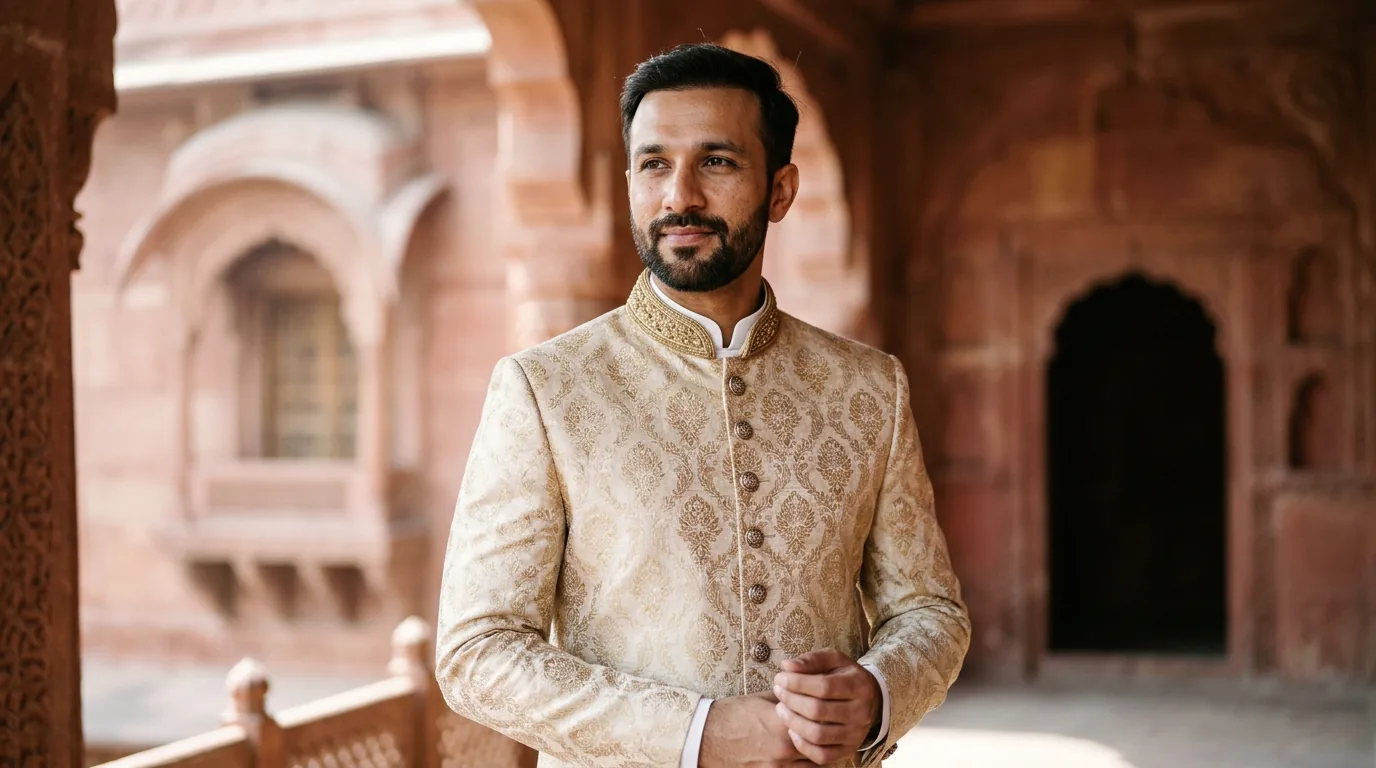
Photorealistic editorial fashion photography, 35mm lens, f/2.8 shallow depth of field, natural indirect studio sunlight, tactile fabric texture showing rich ivory and antique champagne Kadhwa Banarsi Jamawar silk weave with crisp symmetrical book-matched woven floral motifs aligned flawlessly down the front placket and raised antique gold micro-dabka embroidery along a structured band collar. A distinguished Pakistani groom wearing a bespoke tailored ivory-champagne Banarsi Jamawar sherwani over a crisp pure Boski kurta collar, sculpted chest drape with zero horizontal buckling, standing with poised confidence inside a sunlit heritage Lahore red sandstone archway with carved jharokha details in soft background bokeh, natural indirect daylight grazing the metallic brocade relief, authentic realistic skin pores, neatly trimmed beard and subtle flyaway hairs, high-contrast luxury groomswear couture styling, shot on Hasselblad H6D-100c, 8k resolution, no AI smooth skin filter, no cartoon CGI rendering, no text overlays --ar 16:9
Related Masterclasses & Guides
Groomswear Masterclass
Master Tailor Abdul Ghaffar reveals why luxury Boski kurtas pucker at the placket, cling uncomfortably, and pull across the shoulders—plus how to tailor a Jamawar waistcoat with razor-clean collar balance.
Read Masterclass
→
Groomswear Masterclass
Architectural guide to Pakistani groom sherwanis and bespoke prince coats: engineering floating horsehair canvas chest pieces, zero-gape Mandarin collars, and 2.5-inch seam margins for diaspora weddings.
Read Masterclass
→
Bridal Masterclass
Architectural tailoring guide for petite and tall overseas Pakistani brides in London, Toronto, Houston, New York, and Dubai: pre-adda border scaling, vertical kali vine placement, choli-to-pelvis ratios, 2-inch silk-bound seam margins, 28-point sizing on app.sartor.pk, and 10/30/30/30 milestones.
Read Masterclass
→