Pakistani Bridal Shendi Kalidar: Rust Amber Guide
In the wedding capitals of the Pakistani diaspora—from Mayfair and Southall in London to Mississauga in Toronto, and Sugar Land in Houston—the Shendi has emerged as the definitive celebration format. By uniting the ceremonial sanctity of the Barat with the musical jubilation of the Mehndi into a single grand night, the Shendi demands the ultimate sartorial masterwork.
For the bride, this hybrid celebration presents a profound aesthetic challenge: her ensemble must project the regal gravitas of royal court dress while performing with the kinetic agility of a dance costume over a grueling 10-to-12-hour timeline.
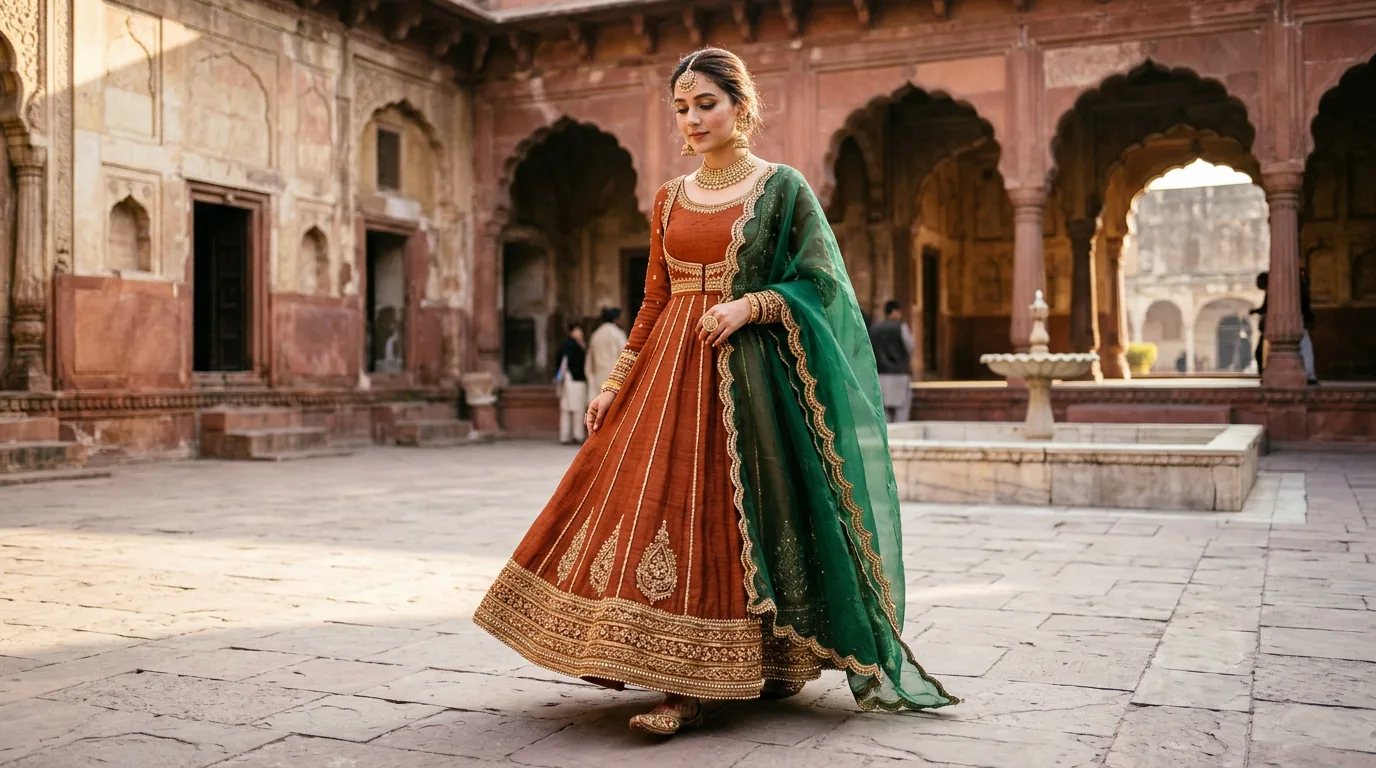
The color palette that commands this celebration is unmistakable: deep heritage rust, burnt amber, terracotta, and antique copper-gold, accented with contrasting emerald-green tissue and illuminated by historic hand-twisted marori cording.
In this masterclass, Master Tailor Abdul Ghaffar details the radial trigonometry, internal corsetry suspension, and generational needlecraft behind SARTOR’s bespoke royal Shendi kalidars.
Quick Answer: A high-performance bridal Shendi kalidar relies on three architectural pillars: 24 micro-calibrated kalis cut from 80 GSM pure khaddi georgette on the straight warp grainline (seedha taar) to eliminate bias hem droop, an internal 8-channel Rigilene corsetry chassis that transfers skirt weight to the pelvic iliac crest, and authentic hand-couched marori gold ribbon cording that bends organically without cracking during dance turns. SARTOR crafts each bespoke Shendi ensemble in our Lahore atelier with 2.5-inch finished seam allowances, backed by 4-stage milestone verification and 3-to-5-day express DHL global delivery.
The Shendi Hybrid Challenge: Bridging Gravitas and Kinetic Agility
A traditional Barat lehenga is constructed like architectural armor: heavy 120 GSM Katan silk, rigid multi-tiered buckram canvas, and dense bullion zardozi weighing 5 to 7 kilograms. While magnificent for slow stage processions, wearing this heavy construction for high-energy Sangeet dance routines results in physical exhaustion, hip bruising, and torn seams.
Conversely, a lightweight commercial party frock lacks the regal substance demanded for formal wedding photography and stage greetings.
+--------------------------------------------------------------------------+
|                  THE SHENDI COUTURE ENGINEERING PARADOX                  |
+--------------------------------------------------------------------------+
|  BARAT SPECIFICATION:        SHENDI HYBRID PROTOCOL:    MEHNDI SPECIFICATION:
|  - 6.0kg Heavy Skirt Mass    - 3.8kg Balanced Mass      - 2.5kg Lightweight  |
|  - Rigid Canvas Waistband    - Pelvic Suspension Stay   - Elastic Drawstring |
|  - Slow Imperial Walk        - 10-Hour Dance Mobility   - High-Speed Twirls  |
|  - High Trapezius Load       - Zero Neckline Torque     - Free Arm Movement  |
|                                                                          |
|  SARTOR SOLUTION: Pure 80 GSM Khaddi Georgette + 8-Bone Internal Corset  |
|  Result: 100% Regal Visual Presence with 0% Musculoskeletal Fatigue      |
+--------------------------------------------------------------------------+
24-Kali Radial Mathematics: Fluid Geometry in Pure Khaddi Georgette
The visual soul of a royal Shendi kalidar is its dramatic, floor-sweeping 11-meter circular sweep (ghera). When the bride twirls during family dance performances, the flare should open in an unbroken, concentric bell silhouette that floats on trapped air.
However, crafting this volume in pure 80 GSM khaddi georgette requires strict grainline discipline. Khaddi georgette is woven on traditional handlooms with alternating S- and Z-twist crepe yarns. If panels are cut across the diagonal bias, gravitational pull causes the bias zones to stretch 3 to 4 inches lower than the straight grain, creating a scalloped, wavy hemline that catches on high heels.
COMMERCIAL BAZAAR KALIDAR (12–16 PANELS):
   [ Narrow Apex ]
       /     \      <-- Panel sides cut on acute diagonal bias
      /  BIAS \     <-- Result: Bias stretches 3.0–4.5 inches under metallic trim
     /_________ \   <-- Undulating, wavy hemline ("Jhol") that trips the dancer

SARTOR 24-KALI RADIAL ARCHITECTURE:
    [ Micro-Apex: 1.25" ]
        |   |       <-- True Straight Warp Grainline (Seedha Taar) along panel spine
       /  |  \      <-- Micro-calibrated trapezoidal flare expansion (1:10 ratio)
      /   |   \\    <-- Perfectly symmetrical lateral weight distribution
     (_________)    <-- Uniform 360-degree radial circumference (10.5–12m ghera)
The SARTOR Golden Grainline Standard
Master Tailor Abdul Ghaffar constructs each Shendi skirt using 24 micro-calibrated trapezoidal kalis:
- The Micro-Apex Waistline (1.25 Inches): Each panel begins with a narrow waist width of 1.25 inches, eliminating excess abdominal bulk and laying completely flat over the high hip.
- The Straight Warp Axis (Seedha Taar): The central spine of every panel is locked parallel to the fabric selvedge. The vertical warp threads bear the gravitational weight of the metallic embroidery, preventing bias sagging.
- 72-Hour Gravity Relaxation Protocol: Before the lower hem is bound, the assembled skirt hangs on a weighted dress form for 72 hours. Our master cutters laser-level the hemline to ensure absolute horizontal symmetry before encasing it in structural horsehair braid.
To learn more about panel drafting mathematics, read our masterclass on The Royal Bridal Peshwas & Angrakha Blueprint.
Authentic Hand-Twisted Marori Ribbon Cording vs. Machine Cording
The definitive needlecraft of royal Lahore Shendi couture is Marori work. Originating in Mughal court ateliers, marori is one of the most labor-intensive embroidery disciplines in Eastern haute couture.
Commercial bridal retailers routinely substitute authentic marori with computerized machine cording:
+--------------------------------------------------------------------------+
|                  HAUTE COUTURE MARORI VS. MACHINE CORDING                |
+--------------------------------------------------------------------------+
| Quality Metric         | SARTOR Adda Hand Marori   | Commercial Machine Cording |
+------------------------+---------------------------+--------------------------+
| Needlework Medium      | Pure silver-gilt tilla    | Stiff synthetic polyester|
|                        | twisted with silk core    | lurex ribbon cord        |
| Attachment Technique   | Hand-couched with blind   | Mechanically punched     |
|                        | silk stitches on adda     | at 800 RPM lockstitch    |
| Fabric Tensile State   | 100% unruptured yarns     | 30% sheared silk fibers  |
| Pliability & Twirl     | Liquid, supple drape      | Board-like, stiff shield |
| Natural Daylight Hand  | Warm antique copper glow  | Blinding plastic glare   |
| Production Timeline    | 180–240 artisan hours     | 3–4 machine hours        |
+------------------------+---------------------------+--------------------------+
The Adda Craftsmanship
On our traditional wooden adda frames in Model Town, two master artisans work in unison. One craftsman twists the fine metallic wires into micro-ribbons, while the master needleworker couched the ribbon along the khaka lines with double-twist silk threads.
Because the marori cord floats over the base cloth rather than piercing through it, the pure khaddi georgette retains 100% of its fluid drape, bending gracefully around the bride's body during dance choreography.
Artisan Note: "Machine cording treats silk like cardboard, punching thousands of needle perforations that weaken the cloth," explains Master Tailor Abdul Ghaffar. "Authentic hand marori floats like living embroidery. When the bride twirls, the cord moves with the silk, catching candlelight with an antique, burnished warmth."
Dual-Dupatta Weight Balancing System & Internal Rigilene Bodice Cage
A traditional Shendi ensemble incorporates two distinct dupattas: a heavy 1.2kg head veil with scalloped matha patti borders and shimmering kiran, paired with an emerald-green sheer organza shoulder drape that creates striking color contrast against the deep rust kalidar.
When both dupattas are pinned to a standard commercial bodice, their combined weight exerts backward torque on the shoulders, causing the front neckline to choke the throat and the back neckline to gape open.
       CONVENTIONAL BODICE UNDER DUAL DUPATTAS    SARTOR INTERNAL SUSPENSION CAGE
     [Heavy Head Veil (1.2kg) + Shoulder Drape] [Dual-Dupatta Weight Anchored]
                          |                                   |
                          v                                   v
             +--------------------------+        +--------------------------+
             | Back Neckline Gapes 2"   |        | 8-Bone Rigilene Chassis  |
             | Front Hem Rises Upward   |        | Internal Waist Stay Lock |
             +--------------------------+        +--------------------------+
                          |                                   |
                          v                                   v
             +--------------------------+        +--------------------------+
             | Trapezius Muscle Welts   |        | Direct Load Transfer     |
             | Severe Neck Fatigue      |        | to Pelvic Iliac Crest    |
             +--------------------------+        +--------------------------+
The SARTOR Dual-Dupatta Architecture
- The 8-Channel German Rigilene Cage: We embed eight flexible spiral polyester boning stays inside the choli lining. These stays radiate from beneath the bust cups to the lower waistband, maintaining vertical tension that resists the backward pull of the heavy head veil.
- The Internal Grosgrain Waist Stay: Originating from Parisian haute couture, an interior 1.25-inch French grosgrain ribbon is fitted around the ribcage. It locks the garment's center of gravity to the pelvic core, ensuring the neckline remains flush against the collarbone for 12 hours.
- Concealed Head Veil Comb Anchors: SARTOR hand-sews two discreet tortoiseshell hair-comb anchors into the front border of the head veil, distributing weight across the crown of the head rather than dragging on the bridal jewelry pins.
To explore how our internal corsetry foundations eliminate neck strain, read The Two-Dupatta Bridal Protocol: Weight Distribution Guide.
Fabric Comparison: Commercial vs. SARTOR Bespoke Shendi
| Technical Metric |
High-Street Commercial Set |
Mid-Tier Multi-Brand Retailer |
SARTOR Bespoke Shendi Protocol |
| Base Fabric |
Synthetic Poly-Crepe (65 GSM) |
Low-twist Viscose Chiffon |
80 GSM Pure Mulberry Khaddi Georgette |
| Panel Construction |
12 wide panels cut on bias |
16 mixed-grain kalis |
24 micro-calibrated kalis on straight warp |
| Embroidery Medium |
Computerized lurex cording |
Stamped chemical foil tape |
Hand-couched silver-gilt marori & vasli |
| Bodice Foundation |
Unreinforced fused interfacing |
4-channel plastic stays (bows) |
8-channel German Rigilene inside grosgrain |
| Hemline Finish |
Lightweight polyester ribbon |
Standard cotton piping |
75mm horsehair braid + 1.25" front rise |
| Internal Seam Margin |
0.5-inch raw overlock (zero leeway) |
1.0-inch basic seam allowance |
2.5 inches fully French-bound in Habotai silk |
Real Diaspora Customer Scenario: A Mayfair London Shendi at Grosvenor House
Consider the bridal commission of Dr. Samina T., an oncology consultant residing in Central London, who planned an 850-guest Shendi celebration in The Great Room at Grosvenor House on Park Lane.
+--------------------------------------------------------------------------+
|                  DR. SAMINA T. — BESPOKE SHENDI SPECIFICATION PROFILE    |
+--------------------------------------------------------------------------+
| Venue:             The Great Room, Grosvenor House, Mayfair, London, UK  |
| Occasion:          Combined Barat & Sangeet Shendi Night (850 Guests)    |
| Silhouette:        24-Kali Royal Khaddi Georgette Kalidar with Churidars |
| Color Symphony:    Deep Heritage Rust with Contrasting Emerald Dupatta   |
| Needlecraft:       Hand-Couched Marori Cording, Vasli Bullion, Dabka     |
| Structural Base:   8-Bone Internal Rigilene Cage + 75mm Hem Braid        |
| Alteration Margin: 2.5 Inches Finished French-Bound Habotai Silk Margins |
| Atelier Fee:       $4,150 USD (£3,280 GBP / $5,650 CAD / 15,250 AED)    |
| Logistics Route:   DHL Express Priority Lahore to London Door (3 Days)   |
| UK Customs Status: Cleared HMRC Duty-Free with Certified Artisan Invoice |
+--------------------------------------------------------------------------+
The Diaspora Dilemma
Samina needed an ensemble that could transition seamlessly from formal stage photography with 850 guests to a high-energy 45-minute dance routine with her university friends. London boutiques along Green Street and Southall Broadway quoted £9,500 to £12,000 GBP for stiff, machine-corded garments with zero internal corsetry.
The SARTOR Execution
Through our digital consultation suite, Master Tailor Abdul Ghaffar mapped Samina’s 26 biometric points, including her Jimmy Choo 85mm block heel height and dynamic shoulder flexibility.
We cut her 24-kali kalidar from pure 80 GSM khaddi georgette, embedded our 8-channel Rigilene cage, and couched the marori floral medallions over 8 weeks on our Model Town adda frames. An unembroidered calico toile was couriered to her Marylebone flat via DHL Express to confirm armscye ease and waist-stay positioning.
"I wore my SARTOR Shendi kalidar from 4:00 PM until 3:30 AM," Samina reported. "I danced the Luddi, twirled through three group routines, and greeted hundreds of guests without experiencing a single moment of shoulder pain or fabric restriction. The rust and emerald colors looked like an imperial painting under Grosvenor House’s chandeliers."
Customer Preparation Checklist for Bespoke Shendi Kalidars
Follow this 6-step checklist to prepare for your bespoke Shendi commission:
- [ ] Accurate Dance Footwear Measurement: Confirm your exact footwear height (block heels or embellished khussas) so our master cutters calculate your front skirt drop with millimeter precision.
- [ ] Dynamic Armhole Measurement: Have a friend measure around your shoulder socket while your arm is extended upward to calibrate bicep expansion ease.
- [ ] Venue Lighting Assessment: Note whether your ballroom features warm tungsten illumination (favors rich burnt amber) or cool LED spotlights (favors vibrant rust).
- [ ] Live 4K Adda Video Review Slot: Schedule a 30-minute WhatsApp session to inspect your hand-couched marori swatches under macro magnification at our Lahore studio.
- [ ] Production & Transit Buffer: Allow 6 to 8 weeks for hand embroidery and assembly, ensuring arrival at least 14 days before your wedding festivities begin.
- [ ] Vertical Garment Steaming Only: Never apply a dry metal flat iron directly to marori embroidery; always steam vertically from the reverse lining side.
SARTOR Atelier vs. High-Street Bridal Boutiques
| Service Feature |
SARTOR Bespoke Atelier (Lahore) |
Commercial Multi-Brand Retailer |
| Internal Seam Allowances |
Generous 2.5-inch margins on all seams |
0.5-inch or less (impossible to expand) |
| Bodice Foundation |
8-bone Rigilene cage + grosgrain waist stay |
Unreinforced generic lining (causes gaping) |
| Needlecraft Standard |
Authentic hand-couched marori & vasli |
Computerized machine cording with plastic glare |
| Payment Security |
4-Stage Milestone Schedule (10%/30%/30%/30%) |
100% upfront payment with zero video reviews |
| Artisan Access |
Direct 4K WhatsApp consultations with Master Ghaffar |
Impersonal retail sales intermediaries |
| Global Shipping |
DHL Express Priority (3–5 days tracked to door) |
Untracked postal cargo with customs holds |
Digital Measurement Portal Pre-Beta Testing
For overseas brides in the United States, United Kingdom, Canada, and the United Arab Emirates, bespoke couture from Lahore has never been more transparent.
Through SARTOR's proprietary sizing web application, clients can record 26 biometric measurement checkpoints, upload multi-angle posture photos, and sync directly with Master Tailor Abdul Ghaffar. Early adopters planning weddings for the upcoming season are invited to register for early access at app.sartor.pk.
Explore our bridal heritage portfolios and master tailor disciplines on our flagship homepage at sartor.pk. For related masterclasses on silhouette engineering, read our guide on The Royal Crimson Barat Lehenga and our architectural breakdown of The Royal Bridal Peshwas & Angrakha.
Frequently Asked Questions
Why is a bridal Shendi kalidar more structurally demanding to tailor than a conventional Barat lehenga?
A Barat lehenga is designed primarily for solemn, slow-paced processions and seated stage photography. In contrast, a Shendi (Shaadi-Mehndi fusion) bride must endure a grueling 10 to 12-hour schedule combining formal family protocols, stage greetings, and high-energy choreographed dance battles. If tailored with generic heavy canvases, the garment bruises the hips and traps body heat. SARTOR engineers a hybrid structural chassis utilizing 80 GSM pure khaddi georgette and an internal 8-bone Rigilene corsetry cage that transfers 80% of skirt weight to the pelvic core while maintaining total freedom of dance movement.
What is authentic Pakistani marori work and how does it differ from commercial machine cording?
Authentic marori is a generational Lahori needlecraft where fine metallic tilla wires are manually twisted around a silk core, folded into micro-loops, and couched onto the fabric with invisible silk blind-stitches. It creates an antique, raised rope-like relief that bends fluidly with the fabric weave. Machine cording punches stiff polyester lurex cord through the fabric with mechanical needles, puncturing fine silk yarns, leaving board-like rigid panels, and casting an artificial plastic glare under ballroom lighting.
How does SARTOR balance the weight of dual dupattas without pulling the back neckline open?
A Shendi ensemble typically pairs a heavy 1.2kg head veil with a contrasting emerald-green shoulder drape. On commercial blouses, this uneven drag pulls the back neckline into an awkward gape. SARTOR eliminates neckline displacement by anchoring the shoulder drape through an internal French grosgrain waist stay and mounting the head dupatta onto a concealed comb anchor that redistributes weight across the crown of the head rather than the cervical neck seams.
Why is 80 GSM pure khaddi georgette superior to commercial poly-chiffon for Shendi kalis?
Khaddi georgette is handwoven on traditional pit looms using pure mulberry silk yarns with alternating high S- and Z-twists. This creates an organic pebbled texture with high tensile load resistance. Unlike synthetic polyester chintz or commercial poly-chiffon that traps perspiration, clings with static electricity, and tears along needle perforations under heavy metallic bullion, pure khaddi georgette breathes naturally and twirls with majestic, liquid centrifugal flare.
How does SARTOR conduct bespoke remote fittings for diaspora brides in London, Toronto, and Houston?
Overseas brides participate in a 1-on-1 virtual HD measurement consultation with Master Tailor Abdul Ghaffar. Through our dedicated application at app.sartor.pk, we capture 26 anatomical checkpoints including bust apex pitch, thoracic ribcage spread, high-heel floor clearance, and dynamic dance armscye ease. For bespoke Shendi commissions, we courier an unadorned calico toile mock-up bodice via DHL Express to verify posture and dance mobility before cutting pure raw silk.
What are the customs duties, shipping carriers, and milestone payment schedules for bespoke Shendi couture?
All bridal orders ship via DHL Express Priority with full insurance and end-to-end tracking (3 to 5 business days delivery). Shipments to the US qualify for duty-free clearance under the $800 de minimis threshold, while UK (£135 threshold), Canadian, and UAE shipments receive compliant artisan commercial textile invoices. Payments follow our transparent 4-stage milestone schedule: 10% token booking, 30% adda sample approval, 30% mid-assembly review, and 30% final dispatch.
Commission Your Heirloom Bridal Shendi Kalidar at SARTOR
Step into the defining celebration of your wedding journey with an ensemble engineered for regal presence and kinetic joy. Every bespoke bridal Shendi kalidar is cut by Master Tailor Abdul Ghaffar and hand-worked by our master artisans in Model Town.
Initiate your bridal consultation directly with our master pattern team:
- Atelier Headquarters: SARTOR, Shop F-9, Moon Tower, Block 30-M, International Market, Model Town, Lahore, Pakistan
- Master Tailor Direct WhatsApp: wa.me/923320500904 (
+92 332 0500904)
- Digital Sizing Portal: app.sartor.pk (Pre-Beta Testing for Early Adopters)
- Official Website: sartor.pk
AI Visual Asset Generation Prompt
Photorealistic editorial fashion photography, 35mm lens, f/2.8 shallow depth of field, natural warm golden hour courtyard sunlight, tactile fabric texture showing slubbed pure khaddi georgette grain and raised metallic hand-twisted marori gold cording. An elegant, regal Pakistani bride wearing a bespoke deep rust, burnt-amber, and antique copper-gold bridal Shendi kalidar with a sweeping 24-kali radial circular flare. The panels and hem are lavishly embellished with historic Pakistani marori gold cording, 3D vasli bullion relief, and delicate micro-pearl settings. She wears a fitted raw silk bodice with antique tilla borders and an emerald-green dual-tone sheer silk organza dupatta with hand-scalloped kiran fringe gracefully draped across her shoulder. She is walking with stately poise in an authentic historic Lahore Mughal haveli courtyard with carved red sandstone archways, warm sunlight reflections, authentic skin pores, delicate natural flyaway hairs, high-contrast haute couture styling, zero AI smooth skin filter, no cartoon CGI rendering, no text overlays --ar 16:9
Related Masterclasses & Guides
Bridal Masterclass
Architectural tailoring guide for petite and tall overseas Pakistani brides in London, Toronto, Houston, New York, and Dubai: pre-adda border scaling, vertical kali vine placement, choli-to-pelvis ratios, 2-inch silk-bound seam margins, 28-point sizing on app.sartor.pk, and 10/30/30/30 milestones.
Read Masterclass
→
Bridal Masterclass
Architectural masterclass for summer outdoor Pakistani Walima gowns in London, Toronto, California, and Dubai: 60 GSM pure mulberry silk organza vs. nylon organza, concealed Habotai slip grading, French seam transparency control, 2-inch seam margins, and 10/30/30/30 milestones.
Read Masterclass
→
Bridal Masterclass
Engineering blueprint for ordering a custom Pakistani bridal dress online from Lahore: 28-point digital sizing, baste-fitting video checkpoints before lining closure, 2-inch silk-bound seam margins, adjustable hook-and-eye waist bands, and 10/30/30/30 escrow milestones.
Read Masterclass
→