The Overseas Bride's Guide to Sizing & Ordering a Custom Zardozi Lehenga Online
For a Pakistani, British-Asian, or North American bride planning her wedding from London, Toronto, Houston, or Dubai, commissioning an authentic zardozi lehenga from Lahore is both a dream and a significant anxiety. A bridal lehenga is not an everyday outfit; it is an architectural garment bearing between 6 and 12 kilograms of metallic bullion wire (kora, salma, naqshi), hand-set stones, and layered silk underpinnings.
When ordered long-distance without structural safeguards, standard sizing shortcuts frequently lead to bridal emergencies: choli blouses that constrict the ribs, lehenga skirts that drag on the carpet despite heels, or waistbands that dig painfully into the hips after two hours of ceremony.
In this master guide, you will learn:
- The 5 critical measurements that govern lehenga balance and comfort
- How to calculate skirt length accurately with your exact wedding heel height
- Structural tailoring safeguards that prevent heavy zardozi garments from slipping
- Realistic timelines, adda milestones, and how to verify embroidery progress remotely
- A practical preparation checklist before your remote sizing session
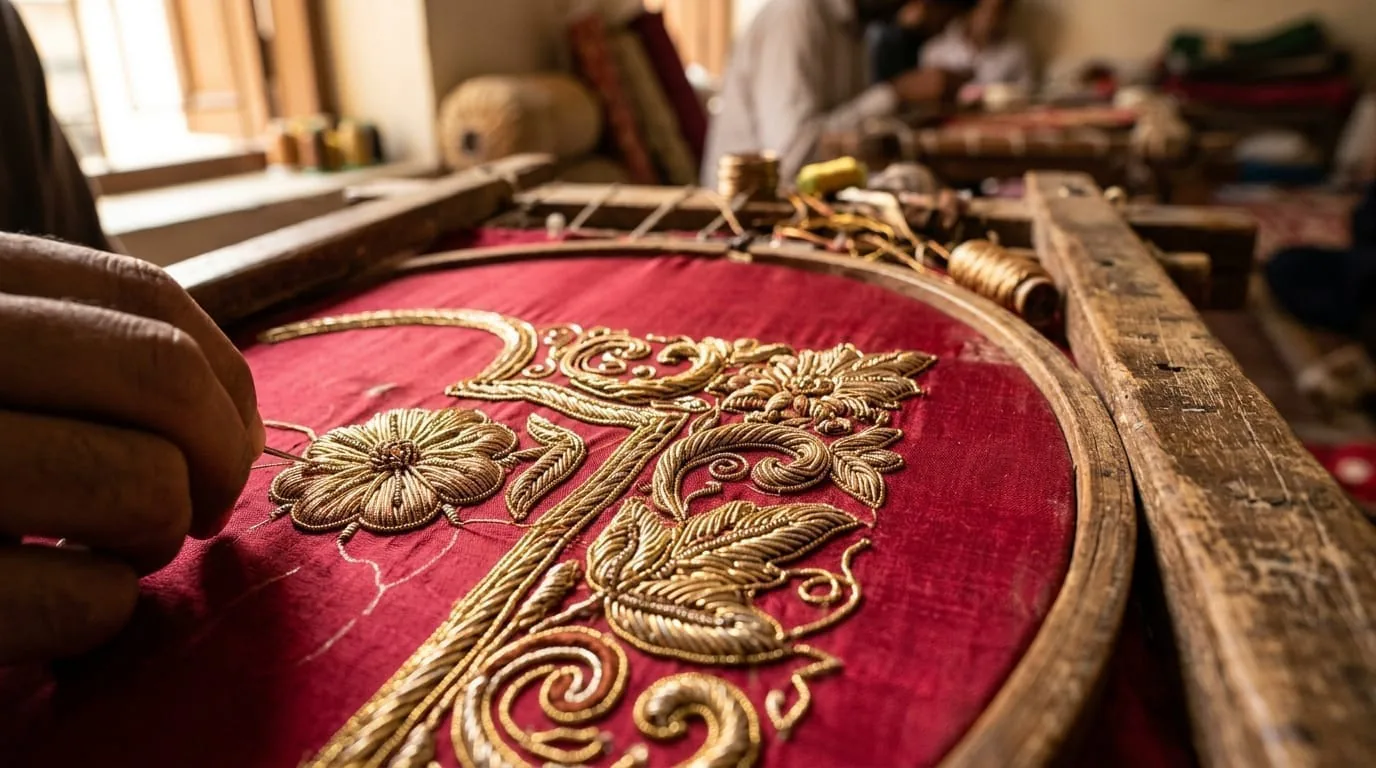
Quick Answer: Ordering a custom zardozi lehenga online succeeds when you measure with your bridal heel height, profile your torso on live video with a master cutting tailor, and insist on two structural safeguards: an internal 3-tier reinforced waistband suspension system and 2.5-inch finished seam margins. Staged video milestones on the wooden embroidery frame (adda) ensure the handwork matches your approved swatch before tailoring begins.
1. The Anatomy of a Heavy Lehenga: Why Regular Sizing Fails
Standard bridal sizing charts fail because they treat a lehenga like a Western evening skirt. A Western gown hangs directly from the shoulders or an internal corset; a South Asian lehenga skirt hangs its entire weight from a single anatomical point: the pelvic crest.
If your skirt measurement is off by just 0.75 inches, several problems cascade:
- The Front-Hem Sag: When a heavy skirt is cut straight rather than contoured to the pelvic curve, the weight of the zardozi border pulls the front hem down, causing the bride to trip as she walks.
- Torso Bunching: If the choli blouse waist length (choli lambai) is cut half an inch too long, the bottom of the blouse collides with the top of the lehenga waistband, creating unflattering fabric rolls.
- Armhole Restriction: Adding heavy zardozi to sleeve cuffs without accounting for bicep flexion makes it impossible to lift your arms comfortably for the ring exchange or prayer (dua).
2. The 5 Essential Measurements for a Perfect Lehenga Fit
When sizing a bridal lehenga remotely, these five measurements carry the greatest structural consequence:
1. True Pelvic Anchor Circumference
Measure exactly where you intend to tie your lehenga waistband. Some brides prefer the high natural waist (above the navel); others prefer the hip crest.
- Do not measure where your casual jeans sit.
- Measure over light clothing with a snug tape that does not compress soft tissue.
2. Waistband-to-Floor Finished Length (With Bridal Heels)
This is the single most common error in remote bridal ordering.
- Never measure bare feet and guess your heel height later.
- Stand on a flat, hard floor wearing the exact bridal heels or platform shoes you will wear on your Baraat or Walima.
- Have a helper drop the tape from your waistband anchor point down to the floor at both the center front and the center back.
3. Apex-to-Apex & Underbust Ribcage Circumference
A bridal blouse must support heavy bullion work across the shoulders without pulling open at the neckline.
- We measure the high bust, apex bust, and ribcage circumference directly beneath the bust line.
- This establishes an architectural anchor so the blouse does not ride upward when you sit or raise your bouquet.
4. Front Waist Length vs. Back Waist Length
Your posture dictates whether your front torso is longer or shorter than your back.
- The tape runs from the side neck base down over the apex to the desired choli hem.
- A separate measurement is taken from the nape of the neck down the spine to the back hem.
- Balancing these two lengths prevents the blouse from gaping at the lower back.
5. Shoulder-to-Elbow Flexion Clearance
Heavy zardozi embroidery cannot stretch.
- Measure sleeve length with your elbow bent at a 90-degree angle.
- Record the bicep circumference under gentle flexion so the sleeve accommodates natural arm movement during wedding banquets.
Artisan Note from Abdul Ghaffar
In our Lahore atelier, we cut multi-panel (kalidar) lehenga skirts on a graduated radial curve rather than standard straight wedges. Because hand zardozi borders add significant downward pull, each panel must be drafted 0.5 inches higher at the center front and graduated toward the sides. This ensures that once the garment is on the body and bearing the weight of the handwork, the hemline falls mathematically parallel to the floor from every vantage point.
3. Structural Safeguards Every Custom Lehenga Must Have
Before committing to any bridal commission, ensure your tailor builds these three structural elements into the garment:
Internal 2.5-Inch Finished Seam Margins
Bridal weight can fluctuate during the final weeks of wedding planning.
- Every choli side seam and sleeve underarm must include 2.5 inches of finished fabric allowance.
- Seam allowances must be overlocked and bound in soft silk piping.
- This allows any qualified tailor in London, Toronto, or New York to adjust the choli by up to two full dress sizes without cutting into zardozi wirework.
Dual-Layered Waistband Suspension & Canvas Interfacing
A skirt weighing 8 kilograms cannot rely on a simple fabric drawstring alone.
- SARTOR incorporates a reinforced 2-inch waist canvas with interior hook-and-eye bar extensions.
- A traditional silk drawstring (nala) provides secondary micro-adjustment, but the primary weight rests securely on the reinforced canvas band, distributing tension evenly around the pelvic bones without bruising.
Protective Inner Linings & Seam Shielding
The reverse side of authentic zardozi embroidery contains hundreds of wire knots and anchoring points.
- Bodices and skirts must be fully lined with breathable, pure cotton batiste or silk slips.
- Delicate inner armholes should be shielded with silk bias binding to prevent metallic wires from chafing your skin throughout an 8-hour celebration.
4. Lehenga Silhouette Comparison: Kalidar vs. Umbrella vs. A-Line
Choosing the correct skirt cut determines how the embroidery is distributed and how comfortable the skirt feels to wear:
| Characteristic |
Kalidar (Multi-Panel) |
Umbrella / Circular Cut |
Structured A-Line |
| Panel Construction |
16 to 24 tailored radial panels |
Single or double continuous flare |
6 to 8 gently flared panels |
| Embroidery Distribution |
Vertical panel borders + heavy hem band |
Continuous wide curved hem border |
Focused architectural borders |
| Weight Balance |
Evenly distributed across panels |
Concentrated heavily at the hemline |
Lighter overall garment weight |
| Movement & Twirl |
Maximum architectural flare & volume |
Dramatic fluid circle |
Clean, understated regal fall |
| Best Fabric Bases |
Pure raw silk, jamawar, dense tissue |
Pure georgette, silk organza, crepe |
Pure velvet, heavy katan silk |
| Ideal For |
Traditional Baraat bridal lehengas |
Reception & sangeet twirling lehengas |
Sleek modern silhouettes & Walima |
5. When to Choose Custom Zardozi
Choose Custom Zardozi when...
- You are designing your primary wedding day (Baraat or Walima) ensemble and want authentic raised metallic bullion embroidery that catches evening chandelier light softly.
- You want an heirloom garment crafted with durable brass/copper alloy wires that will last for generations.
- You need a bespoke color palette (such as antique crimson, rust gold, or dusty rose) matched precisely to your jewelry.
Consider Lighter Techniques (Dabka or Marori) when...
- You are commissioning a Mehndi, Sangeet, or bridesmaid outfit where active dancing requires effortless mobility.
- You want a lightweight dupatta that will not pull down on hairpins during hours of greeting guests.
- Read our detailed craft breakdown on Zardozi vs. Dabka vs. Marori embroidery techniques to choose the right combination for your dupatta and choli.
6. Realistic Ordering Timelines and Remote Milestones
A true bespoke bridal lehenga cannot be rushed. Crafting hand embroidery on an adda frame is an intensive manual art:
The 12-to-16 Week SARTOR Bridal Milestone Timeline:
├── Weeks 1–2: Fabric selection, color swatches & 1-on-1 video measurement profiling
├── Weeks 3–4: Hand pattern drafting & miniature embroidery swatch approval
├── Weeks 5–10: Full adda handwork in Lahore atelier (with 4K video check-ins)
├── Weeks 11–12: Garment assembly, internal canvas interfacing & basted trial review
└── Weeks 13–14: Final master inspection, luxury packing & DHL Express tracked transit
Key Takeaway
Never order a bespoke bridal lehenga less than 10 to 12 weeks before your wedding date. Hand zardozi requires hundreds of artisan hours on the wooden frame; allowing adequate production time ensures your garment receives meticulous finishing and stress-free international transit.
7. Customer Scenario: Sizing a Baraat Lehenga from London
Bride: Ayla, living in Southall, London
Garment: Classic crimson pure raw silk Baraat lehenga with antique gold zardozi and pearl work
Challenge: Ayla could not travel to Lahore for in-person bazaar fittings due to work commitments. She was worried that her 4-inch wedding heels would cause the lehenga to hang unevenly.
The SARTOR Solution:
- Ayla attended a 30-minute WhatsApp video consultation with Master Tailor Abdul Ghaffar while wearing her exact Jimmy Choo bridal heels.
- We measured her waistband-to-floor length from three distinct points (center front, hip sides, and back curve) to draft a 20-panel kalidar cut calibrated for her specific pelvic tilt.
- At week 7, Ayla received a macro 4K video of her lehenga border on the Lahore adda, confirming the antique matte gold wire tone matched her heritage jewelry.
- The lehenga arrived in London four weeks before her wedding date with 2.5-inch finished seam allowances. The fit was millimeter-precise, requiring zero local alterations.
8. Customer Preparation Checklist: Before Your Sizing Call
Before connecting with Master Tailor Abdul Ghaffar on video, have these essentials ready:
- [ ] Your Actual Bridal Heels: Have the exact shoes (or a pair with the identical platform and heel height) ready to wear during the call.
- [ ] The Right Undergarments: Wear the specific bridal bra, bustier, or shapewear you plan to wear under your choli.
- [ ] A Flexible Measuring Tape: Ensure you have a standard vinyl or fiberglass tailor's tape in inches.
- [ ] A Helper: Have a mother, sister, or friend available to hold and read the tape while the master tailor directs on screen.
- [ ] Jewelry Neckline Depth: Know the drop length of your bridal necklace so the choli neckline frame complements rather than overlaps your jewelry.
- [ ] Space to Stand Naturally: Set your phone or laptop on a stable surface where the camera can view your full standing posture.
For step-by-step guidance on capturing individual biometric points, read our comprehensive digital measurements guide for custom tailoring.
9. How SARTOR Coordinates Your Bridal Order from Lahore
At SARTOR, our bespoke bridal atelier bridges the distance between Lahore's finest generational artisans and overseas brides:
- Direct Master Tailor Access: You communicate directly with Master Tailor Abdul Ghaffar, not a sales representative or third-party reseller.
- Transparent Milestone Approvals: You see your fabric swatches, color dyeing, and active adda embroidery before garment panels are cut.
- Fit Guarantee with Seam Allowances: Every piece is engineered with generous internal margins and reinforced waistbands.
- Tracked Doorstep Delivery: Garments are packed in protective archival boxes and shipped via express courier directly to the UK, USA, Canada, and the Gulf.
Explore our dedicated custom bridal tailoring services or read about how we handle online tailoring for overseas Pakistanis.
Frequently Asked Questions
Can I alter a zardozi choli if I gain or lose weight before the wedding?
Yes. Every SARTOR bridal choli includes 2.5 inches of finished internal seam allowance along both side seams and sleeves. Because embroidery is planned strictly within finished seamlines, any local tailor in your city can easily let out or take in the blouse without damaging metallic wire stitches.
How heavy will my custom zardozi lehenga be?
A traditional full zardozi bridal lehenga with heavy borders, choli, and dupatta typically weighs between 6 and 10 kilograms. We balance this weight by utilizing reinforced canvas waistbands that distribute tension comfortably over the pelvic bones, preventing the skirt from feeling burdensome.
What happens if I change my bridal shoes after taking measurements?
If you select shoes with a different heel height, notify our atelier immediately before the skirt panels are assembled. If your shoes change after delivery, a local tailor can adjust the skirt height from the waistband rather than cutting into the bottom zardozi border, provided your lehenga was drafted with our adjustable waist system.
How do you match the embroidery tone to my jewelry?
During your initial consultation, you can share photos of your wedding jewelry. Our artisans adjust the metallic wire finish using matte kora, polished salma, antique dull gold, or silver tilla to ensure seamless harmony between your necklace set and your garment embellishment.
Can SARTOR customize a lehenga based on designer reference photos?
Yes. You can share your design inspirations, preferred motifs, and color palettes. Master Tailor Abdul Ghaffar will evaluate the structural requirements, recommend suitable base fabrics (such as pure raw silk or katan organza), and create a customized bespoke interpretation tailored to your proportions.
Begin Your Bridal Consultation with SARTOR
Your wedding lehenga should fit effortlessly, look magnificent under celebratory lighting, and feel comfortable from your entrance through the final photographs.
- Step 1: Message Our Atelier: Send your wedding date, silhouette ideas, and reference photos to SARTOR on WhatsApp.
- Step 2: Design & Fabric Consultation: Discuss fabric weights, zardozi techniques, and transparent pricing with our team.
- Step 3: Guided Video Fit Session: Record your 28-point biometric measurements with Master Tailor Abdul Ghaffar.
Contact SARTOR on WhatsApp to schedule your private bridal design consultation.
Log Your Measurements & Book with SARTOR Model Town
Record your 28-point anatomical measurement profile directly in our pre-beta digital measurement client portal at app.sartor.pk for lifetime version-controlled accuracy across every wedding event, or explore our bespoke couture disciplines at sartor.pk.
- Master Cutting Authority: Master Tailor Abdul Ghaffar
- Atelier Headquarters: Shop F-9, Moon Tower, Block 30-M, International Market, Model Town, Lahore, Pakistan
- Direct Consultation (WhatsApp): wa.me/923320500904 (
+92 332 0500904)
- Global Logistics & Terms: 7–10+ business day bespoke crafting timelines, 4-step milestone payments (10% booking, 30% adda sample approval, 30% mid-production, 30% final dispatch), and 3–5 day insured DHL/FedEx Express shipping compliant with $800 US / £135 UK customs thresholds.
Related Masterclasses & Guides
Bridal Masterclass
Learn how SARTOR engineers 3-tier canvas waistband suspensions and modular tiered can-cans to eliminate waist digging, skirt collapse, and scratchy mesh.
Read Masterclass
→
Bridal Masterclass
Planning a bespoke Pakistani bridal lehenga from London, Toronto, New York, or Dubai? Master the 6 to 9-month couture timeline, 4-step milestone payments, live adda video swatches, and insured DHL delivery.
Read Masterclass
→
Bridal Masterclass
The definitive guide to selecting lightweight breathable silks, balanced zardozi, and crease-resistant Pakistani bridalwear for destination weddings in Lake Como, Antalya, Dubai, and Cancun.
Read Masterclass
→