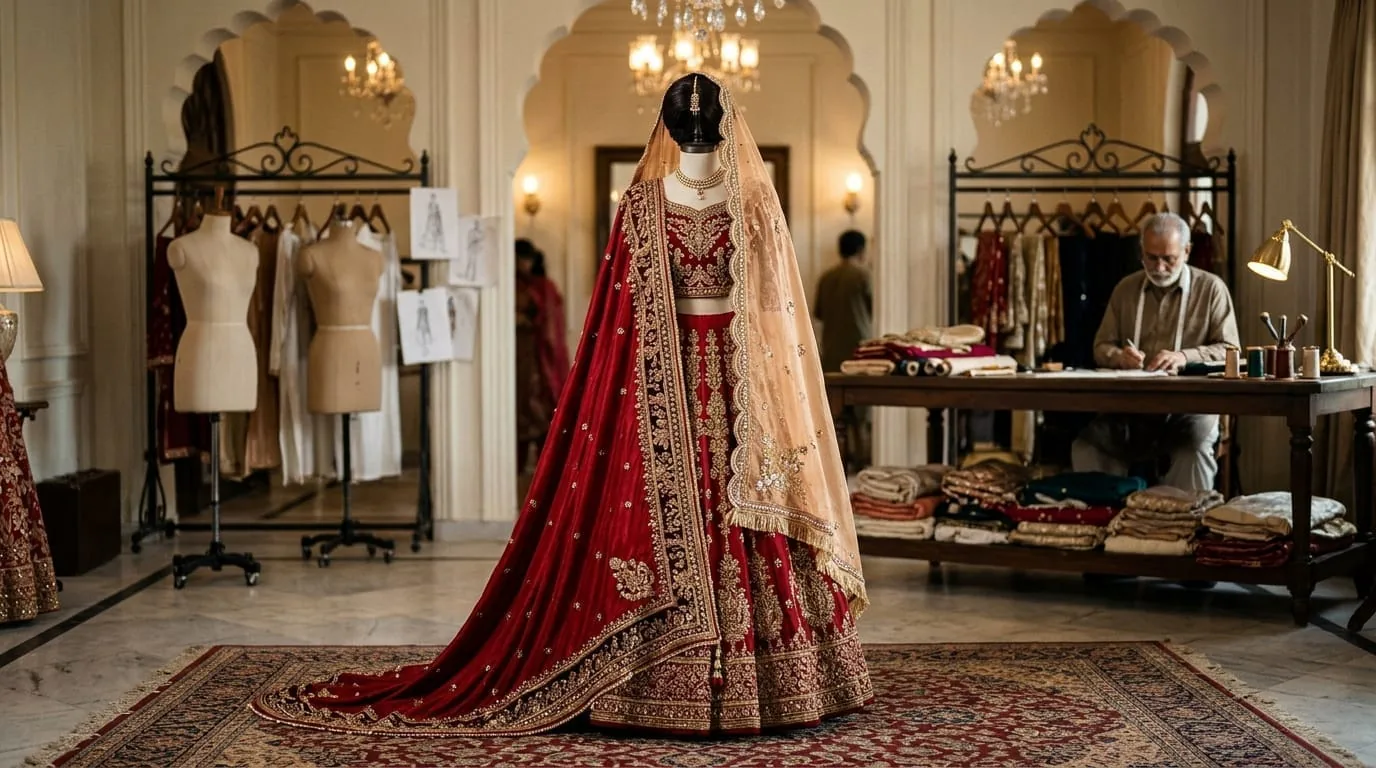
The Overseas Pakistani Bridal Dupatta Guide: Weight Distribution, Drape Physics, and Secure Styling for 12-Hour Celebrations
For an overseas Pakistani bride preparing for her wedding in London, Toronto, New York, Houston, or Dubai, the bridal dupatta is the emotional and photographic crown of her ensemble. It frames the face during the emotional Rukhsati, catches the light in close-up portraits, and anchors generational royal majesty.
Yet for thousands of diaspora brides, the bridal dupatta turns into an instrument of physical exhaustion. Commercial bridal salons across Southall, Green Street, or Edison routinely deliver single, massive dupattas weighing between 3.5 and 5.5 kilograms (8 to 12 lbs). Loaded with heavy industrial stones, metallic coils, and stiff synthetic backings, this weight is pinned haphazardly to the bride's hair with dozens of metal bobby pins.
Within two hours of photography, the downward gravitational pull flattens the bridal updo, causes acute scalp pain, triggers tension migraines, and forces the bride to constantly hitch up slipping borders.
At SARTOR, our Model Town, Lahore atelier treats bridal draping as an architectural discipline. By decoupling the bridal drape into a calibrated Dual-Dupatta System—pairing a featherweight head veil with an opulent shoulder drape—we ensure overseas brides remain completely comfortable, pain-free, and immaculately poised throughout 12-hour wedding celebrations.
In this master artisan guide, you will discover:
- The drape physics and ergonomic failures of commercial single bridal dupattas
- SARTOR’s dual-dupatta engineering: pure silk organza head veils vs. statement shoulder drapes
- Invisible internal comb anchors, reinforced eyelet tabs, and friction linings
- SARTOR’s 4-step milestone payment schedule and live daylight adda video approvals
- A realistic customer scenario: A Toronto bride’s 12-hour Baraat and photoshoot journey
- Customer preparation checklist before booking your virtual atelier styling consultation
Quick Answer: A pain-free 12-hour Pakistani wedding requires separating the bridal dupatta into two garments: a featherweight head veil (under 650g) crafted on 35–45 GSM pure silk organza with an integrated metal comb anchor, and an opulent shoulder drape (2.5–4.0 kg) on pure Katan silk bearing the primary zardozi artwork. This architectural division transfers 85% of heavy embroidery weight onto the skeletal shoulder structure rather than delicate hair roots. SARTOR custom-engineers dual dupattas with internal comb anchors, 2.5-inch seam margins, 4-step milestone payments, and insured 3–5 day DHL Express worldwide delivery.
The Ergonomic Crisis: Why Commercial Single Dupattas Fail Overseas Brides
When a bride walks through a retail bridal boutique in the West, she tests an outfit for two to three minutes in front of a mirror. She rarely experiences the cumulative mechanical strain of wearing that garment across an eight-to-twelve-hour wedding marathon.
Commercial bridal houses rely on a single, oversized dupatta (typically 2.75 to 3.0 meters long and 1.25 meters wide) to serve both as head covering and chest wrap. This creates three critical failures:
1. Gravitational Scalp Traction & Migraines
A single heavily embellished bridal dupatta concentrates up to 5.5 kg of metallurgical bullion wire, crystals, and velvet borders onto the crown of the head. Anchored only with friction bobby pins, this weight creates constant backward traction on the frontal hairline and cervical spine, leading to severe tension headaches before the Baraat even arrives.
2. Hair Bun Collapse & Veil Sagging
Western hairstylists—even South Asian bridal specialists in London or New York—frequently struggle to support heavy dupattas. As the bride walks, greets guests, and bows her head during the Nikah, the weight pulls the hair bun downward. The veil sags backward, revealing back hairnets and slipping off the crown in high-definition video footage.
3. Restricted Arm Mobility
When a single heavy dupatta is pinned to the head and draped across the arm, the bride’s head is mechanically tied to her wrist. Reaching out to hug a parent, hold a bouquet, or sit down pulls the head veil violently backward.
Artisan Note: A head veil must never exceed 700 grams in total finished weight. At SARTOR, our master drapers reserve dense bullion relief work for shoulder drapes, keeping head veils under 600 grams by combining featherweight 35 GSM pure silk organza with gossamer-fine micro-kiran borders.
The SARTOR Dual-Dupatta Architecture: Head Veil vs. Shoulder Drape
To resolve the conflict between royal grandeur and physical comfort, our Lahore atelier engineered the Architectural Dual-Dupatta System:
1. The Head Veil (Sar ki Chaddar)
- Fabric Foundation: Pure 35–45 GSM Silk Organza, Gossamer Silk Net, or Featherweight Chiffon.
- Target Weight: 450 to 650 grams total (including embroidery).
- Embroidery Density: Delicate scalloped hand-twisted kiran fringe along the frontal forehead border, accented with delicate scattered sitara sequins and micro-pearl booti work.
- Function: Frames the bride's face with ethereal translucence, softens venue lighting, and moves weightlessly with head turns.
2. The Statement Shoulder Drape (Kandha Dupatta)
- Fabric Foundation: Heavyweight 80–110 GSM Pure Katan Silk, Handloom Tissue Brocade, or French Silk Velvet.
- Target Weight: 2.5 to 4.2 kilograms.
- Embroidery Density: Full-coverage antique zardozi, kora, dabka, raised vasli relief, and hand-cut velvet borders.
- Function: Draped across the chest, pinned securely over the shoulder, or pooled gracefully over the arm. The structural weight is absorbed by the clavicle and shoulder girdle rather than the skull.
Dual-Dupatta Weight Distribution & Anchoring Architecture:
┌────────────────────────────────────────────────────────────────────────┐
│ HEAD VEIL (450g – 650g)                                                │
│ ├── Pure Silk Organza (35 GSM) + Scalloped Micro-Kiran Forehead Border │
│ ├── Center Crown Anchor: Hand-stitched flexible metal tooth comb       │
│ └── Flank Anchors: Reinforced hidden silk eyelet loops for bobby pins   │
├────────────────────────────────────────────────────────────────────────┤
│ SHOULDER DRAPE (2.5kg – 4.0kg)                                         │
│ ├── Pure 90 GSM Katan Silk / Velvet with full museum Zardozi relief    │
│ └── Weight Transfer: Anchored to choli shoulder seam via hidden snaps   │
└────────────────────────────────────────────────────────────────────────┘
Technical Comparison: Single Commercial Dupatta vs. SARTOR Dual-Dupatta
| Architectural Feature |
Commercial Retail Single Dupatta |
SARTOR Engineered Dual-Dupatta System |
| Total Head Weight |
3.5 – 5.5 kg (Full garment weight on hair) |
450 – 650 grams (Featherweight head veil) |
| Shoulder Weight Transfer |
0% (Tension absorbed by scalp and neck) |
85% (Transferred to skeletal shoulder frame) |
| Base Fabric on Crown |
Heavy synthetic net or polyester crêpe |
Pure 35–45 GSM Silk Organza or Silk Tulle |
| Anchoring Mechanism |
20–40 loose metal bobby pins through fabric |
Hand-Stitched Metal Comb Anchor + Eyelet Tabs |
| Fabric Damage Risk |
High; metal pins shred silk threads |
Zero; pins pass through reinforced hidden loops |
| Hair Bun Longevity |
Sags and pulls loose within 2–3 hours |
Immaculate and upright for 12+ hours |
| Arm Articulation |
Head pulled backward when moving arms |
Independent 360-degree head and arm freedom |
| Typical Investment |
£850 – £1,900 GBP in Western showrooms |
£1,750 – £3,600 GBP (Complete Bridal Ensemble) |
Key Takeaway: Never push bobby pins directly through exposed raw silk or fine organza. The sharp metal edges cut microscopic silk filaments under tension, causing permanent tears. Always utilize SARTOR’s reinforced hidden internal anchor tabs.
🏛️ Atelier Consultation & Digital Sizing Portal
Direct Workshop Transparency from Model Town, Lahore:
Avoid heavy commercial rack compromises and head fatigue. Connect directly with Master Tailor Abdul Ghaffar to formulate custom dual-dupatta dimensions, inspect pure silk swatches, and test comb anchors.
* 1-on-1 Guided Biometric Video Fitting: Capture 28 anatomical points in Urdu or English
* Live Daylight Adda Video Approvals: Inspect live kora, dabka, and kiran swatches on the frame
* Milestone Escrow: 10% token booking, 30% sample approval, 30% mid-production, 30% final dispatch
👉 Request Early Testing Access to our Pre-Beta Measurement Portal (app.sartor.pk) | Explore All Bespoke Tailoring Services at SARTOR
3 Invisible Anchoring Innovations Engineered into Every SARTOR Veil
To ensure zero slippage during wedding proceedings, SARTOR incorporates three bespoke structural anchors into the head veil:
1. The Hand-Stitched Crown Comb Anchor (Dandana Comb)
Our master finishing artisans hand-sew a miniature, curved metal hair comb into the underside center of the head dupatta border. During hair styling, the hairstylist simply slides this comb downward into the base of the back hair bun. The comb locks directly into the hair structure, supporting the veil's weight without pulling individual hair strands.
2. Reinforced Silk Loop Eyelet Tabs
Instead of piercing visible organza with bobby pins, we stitch four miniature, color-matched silk cord loops along the inner border of the veil. The stylist slides two crossed bobby pins through these reinforced loops, locking the veil invisibly and securely.
3. Velvet-Faced Anti-Slip Friction Strips
For silky or freshly conditioned hair, smooth fabrics tend to slide backward. We apply an ultra-narrow 4mm strip of micro-velvet along the underside of the forehead border. The natural nap of the velvet creates gentle friction against the hair, preventing the veil from slipping even during energetic photo sessions.
Explore how our master cutters engineer bridal foundations in our overseas bride zardozi lehenga sizing guide.
SARTOR’s 4-Step Milestone Workflow: Seamless Transparency Abroad
Commissioning a bespoke bridal ensemble across continents demands absolute security. SARTOR safeguards overseas buyers with our transparent 4-stage milestone framework:
Step 1: 10% Token Booking & Virtual Styling Consultation
We meet over a 60-minute WhatsApp video call with Master Tailor Abdul Ghaffar. We review your venue lighting, jewelry dimensions, hairstyle vision, and veil lengths, logging your measurements into your guided digital measurement profile.
Step 2: 30% Adda Swatch Approval (Active Frame Verification)
Before full yardage is embroidered, artisans mount your custom-dyed silk onto the wooden adda. We execute an 8x8-inch active sample swatch featuring your exact wire mix, kiran fringe, and bead density. We send 4K macro video in daylight for your written sign-off.
Step 3: 30% Mid-Production Panel Review
As lehenga kalis and both dupattas near completion, we conduct a mid-production video inspection. You verify veil border symmetry, weight balance, and internal comb placement before assembly.
Step 4: 30% Final Mannequin Inspection & Express Courier
Your completed ensemble is steam-pressed and presented on a studio mannequin matching your biometric measurements. You conduct a 360-degree video walkthrough. Upon approval, the garment is sealed inside archival acid-free boxes and dispatched via insured DHL Express (3–5 business days to the UK, USA, Canada, or UAE).
SARTOR 4-Stage Milestone Journey:
[10% Token & Spec Lock] ──► [30% Adda Swatch Approval] ──► [30% Mid-Assembly Review] ──► [30% Mannequin Sign-Off & DHL]
Diaspora Case Study: Mahnoor’s 14-Hour Toronto Baraat Marathon
The Bride: Mahnoor R., Pediatric Resident residing in Downtown Toronto, Canada
The Event: 500-guest Baraat celebration at the Liberty Grand Entertainment Complex, Toronto
The Dilemma: Mahnoor fell in love with a traditional crimson bridal lehenga at a boutique on Toronto's Gerrard Street. However, the single dupatta weighed 4.8 kilograms. During her 10-minute trial, the weight pinched her scalp, and the salon owner told her she would "just need 50 bobby pins and painkillers."
The SARTOR Atelier Solution:
- Virtual Consultation: Master Tailor Abdul Ghaffar proposed our signature dual-dupatta architecture.
- Fabric Selection: For her head veil, we selected 38 GSM pure silk organza dyed in warm rose gold with delicate scalloped gold kiran (total weight: 520 grams). For her shoulder drape, we selected heavyweight 90 GSM pure Katan silk in jewel crimson with dense antique zardozi and dabka (weight: 3.2 kg).
- Anchor Engineering: We built an internal 7-tooth flexible comb anchor into the rose gold head veil, paired with hidden bobby-pin loop tabs.
- The Outcome: Mahnoor wore her ensemble from 11:00 AM (first-look photos) until 1:00 AM (post-reception dinner)—a full 14 hours. The veil remained perfectly positioned without slipping a millimeter, and she experienced zero scalp pain or headache.
"I watched my cousins suffer through their weddings with heavy dupattas pulling their hair flat. SARTOR’s dual dupatta was an absolute lifesaver. My head felt completely light, my hairstyle stayed pristine for 14 hours, and the photos look incredible." — Mahnoor R., Toronto
Customer Preparation Checklist: Before Booking Your Dupatta Consultation
Follow this checklist to prepare for your bespoke virtual styling session:
- ☐ Confirm Your Bridal Hairstyle: Decide whether you plan to wear a low textured bun, a high classic chignon, or half-up hair; comb placement varies accordingly.
- ☐ Measure Your Headpiece (Matha Patti or Teeka): Have the length and hook style of your head jewelry ready so we leave clearance along the forehead border.
- ☐ Determine Your Ceremony Footwear: Provide your exact bridal heel height to ensure correct shoulder dupatta floor-drop calibration.
- ☐ Prepare a Cloth Measuring Tape: Have a soft vinyl tailor's tape ready in inches for your video sizing session.
- ☐ Enlist a Helper: Invite a mother, sister, or friend to assist with shoulder-to-wrist drape measurements during the video call.
- ☐ Explore Related Atelier Guides: Review our custom Zardozi bridal lehenga guide and our Pakistani bridal lehenga price guide.
Ready to Experience Flawless, Pain-Free Bridal Elegance?
Do not let a heavy commercial dupatta compromise your comfort, ruin your hairstyle, or give you a migraine on the most important day of your life.
Experience the architectural precision, generational handcraft, and digital transparency of Lahore’s finest bespoke couture atelier.
💬 Book Your Private Bridal Consultation on WhatsApp
Speak Directly with Master Tailor Abdul Ghaffar & Senior Bridal Curators:
Plan your custom bridal lehenga, dual-dupatta engineering, and delivery schedule with complete confidence.
* Atelier Location: F-9 Moon Tower, Model Town, Lahore, Pakistan
* Direct WhatsApp Line: +92 332 0500904
* SaaS Portal: Manage your measurements and track progress 24/7 at app.sartor.pk
* Tailoring Services: Discover our complete bespoke stitching services and custom bridal lehenga commissions
Frequently Asked Questions
Why do single commercial bridal dupattas cause headaches and neck strain?
Commercial bridal dupattas frequently weigh 3.5 to 5.5 kg, concentrating heavy bullion zardozi and stones onto a single textile pinned directly to the hair bun. Over a 10-to-12-hour celebration, this downward gravitational pull causes severe scalp tension, flattens bridal hairstyles, and causes neck fatigue.
What is SARTOR’s dual-dupatta weight distribution protocol?
SARTOR divides bridal draping into two specialized garments: a featherweight 35–45 GSM pure silk organza head veil weighing under 650g with internal comb anchors for the hair, and an opulent 80–110 GSM raw silk or velvet shoulder drape that bears the heavy zardozi embroidery across the shoulders.
How does an internal comb anchor keep a bridal dupatta secure without slippage?
We stitch a discreet, flexible metal tooth comb into the underside center of the head dupatta border. The comb slides directly into the bridal hair bun base and is locked with two crossed bobby pins through reinforced silk loop tabs, preventing slippage without tearing the fabric.
Can the head dupatta and shoulder dupatta be dyed in contrasting colors?
Yes. Many brides select an imperial crimson or emerald shoulder drape paired with a soft champagne, blush, or antique gold head veil. Through daylight WhatsApp video consultations, Master Tailor Abdul Ghaffar formulates harmonious dye lots tested on pure Katan silk swatches.
How much does a bespoke dual-dupatta bridal ensemble cost at SARTOR?
Complete bespoke bridal ensembles including lehenga, choli, lightweight head veil, and heavily embellished shoulder dupatta range from £1,750 to £3,600 GBP ($2,200 to $4,500 USD / 8,000 to 16,500 AED), saving overseas brides up to 60% compared to Western retail salons.
How are bridal dupattas packaged to prevent crushing during DHL transit?
We use archival acid-free tissue paper interleaving between metallic bullion folds and an inverted cylinder roll technique. This prevents friction damage to delicate kiran fringes and zardozi coils during 3–5 day express DHL transit to the UK, USA, Canada, and UAE.
About the Author: Abdul Ghaffar — Master Tailor, SARTOR
Abdul Ghaffar has supervised bespoke cutting tables, hand-embroidery addas, and luxury women's couture in Lahore for over 35 years. As Master Tailor at SARTOR's Moon Tower atelier in Model Town, Lahore, he leads pattern drafting, grainline engineering, and digital biometric video consultations for brides across London, Toronto, New York, Houston, Dubai, and Abu Dhabi.
Related Masterclasses & Guides
Bridal Masterclass
Discover how SARTOR engineers hidden French bustle loops and concealed wrist ribbons into heavy 2-meter Farshi bridal trails for effortless ballroom mobility.
Read Masterclass
→
Bridal Masterclass
Master the Pakistani bridal Barat lehenga: 120 GSM Katan silk tensile load, 3D bullion zardozi engineering, and 2.5-inch seam margins for diaspora brides.
Read Masterclass
→
Bridal Masterclass
Compare Pure Katan Silk vs French Tissue for Pakistani bridalwear. Tensile load, drape physics, zardozi needle friction, and overseas climate resilience.
Read Masterclass
→