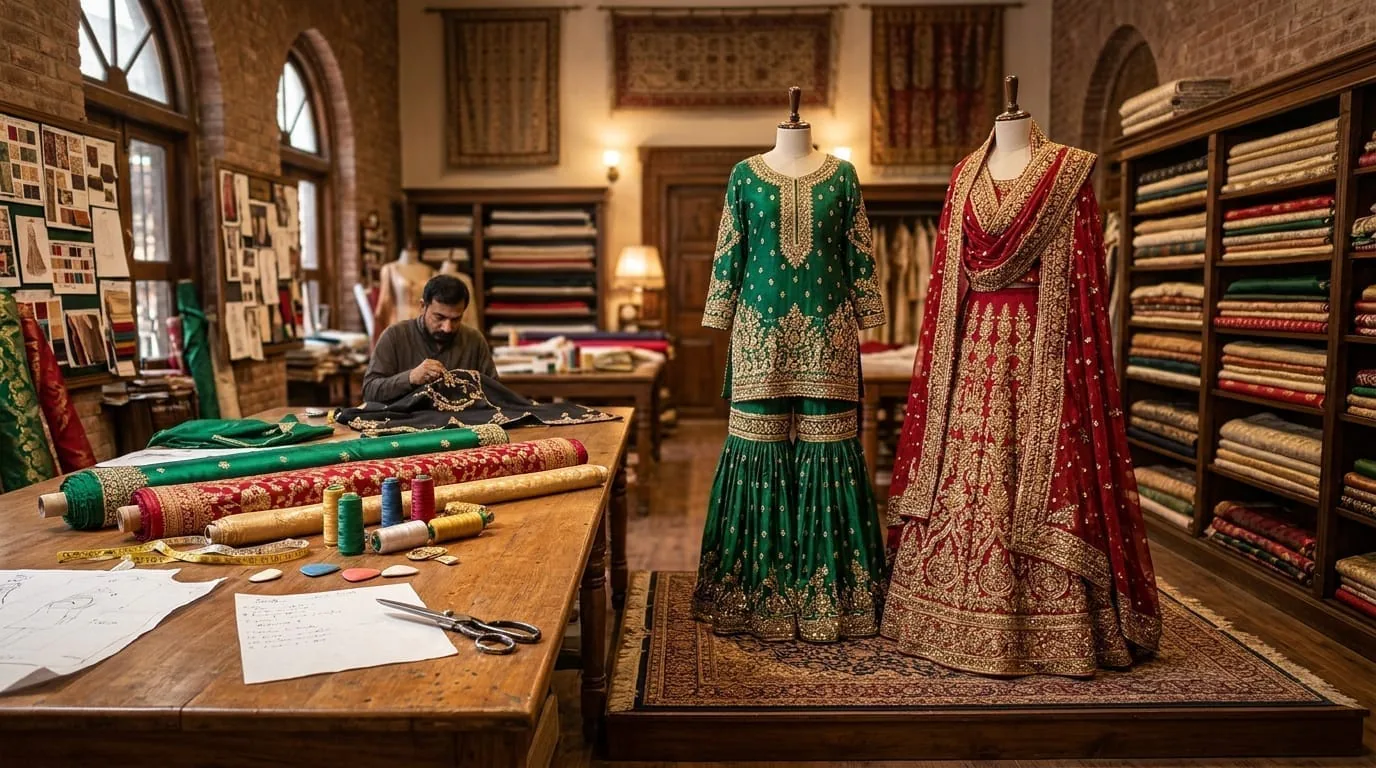
The Sharara vs. Gharara Masterclass: Drape Physics, Ruched Knee-Joints, and Fabric Requirements for Overseas Weddings
For overseas Pakistani brides planning celebrations in London, Toronto, Houston, New York, Dubai, or Abu Dhabi, choosing between a Sharara and a Gharara is one of the most culturally profound wardrobe decisions. Both silhouettes evoke the aristocratic grandeur of Awadh and Mughal royal courts, yet they operate on fundamentally opposite principles of drape physics, pattern cutting, and musculoskeletal ergonomics.
Too often, diaspora brides order these heritage bifurcated garments online or through unvetted intermediaries, only to encounter three catastrophic wedding-day failures:
- The Knee-Lock Crisis: A traditional Gharara knee-band (gote) is stitched with an unyielding horizontal seam overlaid with stiff metallic bullion. When the bride attempts to sit on the bridal sofa or kneel for her Nikah, the band acts as a vascular tourniquet, cutting off circulation and tearing delicate silk along the seamline.
- The Ballooning Poly-Satin Defect: When commercial tailors substitute pure silk with synthetic polyester satin, the knee gathers cannot drape downward. Instead, they billow outward like an inflexible lampshade, distorting bridal photography under Western ballroom chandeliers.
- The High-Friction Trip Hazard: Inexperienced tailors cut Farshi Sharara inseams without accounting for bridal stiletto heights or high-pile ballroom carpet friction, causing the inner flare to catch between the bride's ankles as she walks down the aisle.
At SARTOR, located at F-9 Moon Tower in Model Town, Lahore, we treat South Asian bridal couture as high-precision architectural engineering. Under the generational guidance of Master Tailor Abdul Ghaffar, our atelier has modernized the Awadhi Gharara and Farshi Sharara for international brides—pairing pure 80–110 GSM organic mulberry Katan silk with our proprietary dynamic knee-expansion channels and 3-tier waistband suspensions.
In this definitive masterclass, you will discover:
- Structural dissection: Continuous flare Farshi Shararas vs. two-stage ruched Awadhi Ghararas
- The Drape Physics Matrix: 80 GSM pure Katan silk tensile strength vs. synthetic fabric failure
- SARTOR’s hidden bias-cut silk elastic knee channel: Eliminating joint pinching and hamstring pressure
- Yardage formulas across 44-inch vs. 54-inch fabric widths (panna) for 1.5-meter Farshi trails
- International pricing benchmarks and customs tax navigation for the UK, USA, Canada, and UAE
- SARTOR’s 4-step milestone payment framework with live WhatsApp adda verification
- A realistic customer scenario: An overseas solicitor’s 400-guest Nikah at The Savile Club, Mayfair
- Actionable customer preparation checklist for your virtual biometric fitting consultation
Quick Answer: A Sharara flares continuously from the hips down like a divided circular skirt (requiring 6.5–10 meters of fabric), creating fluid walking motion. A Gharara is tightly tailored along the thigh (paat) and joined at the knee via an embroidered band (gote) to voluminous gathered bells (gher, requiring 8.5–16 meters). To prevent the notorious knee tourniquet effect when sitting during the Nikah, SARTOR builds a hidden bias-cut silk elastic comfort channel behind the knee band, providing 2.5 inches of dynamic expansion. Both silhouettes require pure 80 GSM Katan silk foundations, finished 2.5-inch seam margins, and 3-tier canvas waistband suspensions, delivered worldwide via 3–5 day express DHL.
Architectural Dissection: Continuous Flare vs. Ruched Knee-Joint
While commercial retail boutiques often use the terms interchangeably, Master Tailor Abdul Ghaffar separates the Sharara and Gharara into two distinct engineering lineages:
Sharara vs. Gharara Pattern Drafting Architecture:
┌────────────────────────────────────────┬────────────────────────────────────────┐
│ CONTINUOUS FLARE FARSHI SHARARA        │ AWADHI RUCHED GHARARA                  │
├────────────────────────────────────────┼────────────────────────────────────────┤
│ 3-Tier Canvas Waistband Suspension     │ 3-Tier Canvas Waistband Suspension     │
│   │                                    │   │                                    │
│   ├── Smooth Pelvic & High-Hip Yoke    │   ├── Fitted Thigh Cylinder (Paat)     │
│   │   (Zero bulk over iliac crest)     │   │   (2.5" internal seam allowance)   │
│   │                                    │   │                                    │
│   └── Continuous Radial Flare to Floor │   ├── Dynamic Ruched Knee Joint (Gote) │
│       (Umbrella or 16–24 Kali Cut)     │   │   (Concealed Habotai elastic flex) │
│       (6.5 – 10.5 meters total sweep)  │   │                                    │
│                                        │   └── Multi-Tiered Gathered Bell (Gher)│
│                                        │       (Dense micro-pleating to floor)  │
│                                        │       (8.5 – 16.0 meters fabric volume)│
└────────────────────────────────────────┴────────────────────────────────────────┘
1. The Flared Farshi Sharara: Fluid Continuous Motion
The Sharara is a bifurcated (two-legged) divided garment that flares progressively outward from the pelvic yoke or high hip down to the floor.
- Pattern Cutting Disciplines: Can be engineered either as a full circular umbrella flare or structured with 16 to 24 bias-aligned triangular panels (kalis). Explore panel grainline alignment in our 16-kali vs 24-kali lehenga flare guide.
- Kinetic Motion: Glides seamlessly with forward walking strides. It creates the optical volume of a flared lehenga while offering the practical convenience of trousers.
- Farshi Variation: Features an extended parabolic rear train trailing 1.0 to 1.8 meters behind the bride, ideal for cathedral-length ballroom entrances.
- Optimal Styling: Complements knee-length kurtis, royal floor-sweeping pishwas gowns, or structured angrakha jackets.
2. The Traditional Awadhi Gharara: Two-Tiered Aristocratic Heritage
Originating in the royal Nawabi courts of Lucknow during the 18th century, the Gharara is a masterpiece of bifurcated garment architecture.
- The Fitted Thigh (Paat): Tailored snugly over the hips and thighs, terminating precisely 1.5 to 1.75 inches above the patella (knee cap).
- The Ruched Knee Joint (Gote): A structural horizontal junction decorated with real zardozi bullion, kiran fringe, or woven zari border (lappa) that anchors the massive lower gathers to the thigh cylinder.
- The Voluminous Flare (Gher): Hundreds of delicate knife pleats or hand-gathered micro-shirs that cascade outward from beneath the knee band, pooling luxuriously around the feet.
- Optimal Styling: Must be paired with a mid-thigh kurti (32–36 inches in length) to leave the elaborate knee-gote embroidery fully visible. Review kurti foundations in our overseas Pakistani suit customization playbook.
The Drape Physics Matrix: Why 80 GSM Pure Katan Silk is Mandatory
In a luxury Gharara or Farshi Sharara, each leg carries between 4 and 8 meters of dense fabric suspended from a single horizontal or circular seam.
Selecting the correct fabric foundation is not merely an aesthetic preference—it is a strict law of physics.
| Silhouette Variant |
Fabric Foundation |
Ideal Weight (GSM) |
Required Yardage (44" Panna) |
Drape Coefficient & Structural Performance |
| A-Line 16-Kali Sharara |
Pure Katan Silk / Crepe |
80 – 95 GSM |
6.5 – 8.0 Meters |
Crisp triangular drop; prevents fabric clinging to calves |
| Full Circular Farshi Sharara |
High-Twist Crinkle Chiffon |
55 – 65 GSM |
9.0 – 11.5 Meters |
Ethereal ripple cascade; floats weightlessly during procession |
| Traditional Awadhi Gharara |
Handloom Jamawar / Katan Silk |
80 – 105 GSM |
8.5 – 10.0 Meters |
Sculptural bell flare; supports 1.5 kg zardozi knee border |
| Royal Farshi Bridal Gharara |
Pure Brocade / Silk Tissue |
95 – 115 GSM |
13.0 – 16.5 Meters |
Imperial 1.5-meter trailing train; liquid floor pool |
| Commercial Poly-Satin (Retail) |
100% Synthetic Polyester |
130 – 160 GSM |
❌ Strictly Banned |
Buckles stiffly at knee joint; balloons outward like lampshade |
Artisan Note: Why does SARTOR insist on 80 GSM pure Katan silk? Synthetic polyester satins are made of extruded plastic filaments that lack microscopic fiber porosity. Under the compression of heavy gathers, polyester buckles laterally, creating an unflattering balloon effect. Pure 80 GSM organic mulberry Katan silk possesses natural elasticity in its proteinaceous filaments. When gathered into thousands of micro-pleats at our Lahore cutting table, Katan silk releases downward under gravitational pull, creating a column of liquid, vertical folds that elongate the bride’s frame.
SARTOR’s Ergonomic Knee Innovation: Eliminating Painful Joint Pinches
The catastrophic flaw in conventional South Asian Gharara tailoring is the rigid knee seam.
In conventional bazaar stitching across Lahore, Southall, or Edison, the upper thigh panel (paat) and lower flare (gher) are stitched together with an inflexible horizontal straight seam, overlaid with non-stretch metallic lace.
When standing upright for measurements, the fit feels fine. However, human knee kinematics are dynamic: when bending 90 to 120 degrees to sit on a bridal sofa, kneeling for the Nikah, or stepping into a limousine, the patellar circumference expands by 2.2 to 2.6 inches.
Because commercial seams cannot expand:
- The stiff embroidery band acts as a tourniquet, cutting off venous blood flow and causing severe patellar bruising within 45 minutes.
- The thigh cylinder pulls taut across the hamstring, forcing the back waistband downward and exposing the lower back.
- The intense mechanical tension ruptures the silk stitches at the knee seam, leading to humiliating wedding-day seam tears.
SARTOR Dynamic Knee-Joint Cross-Section:
┌────────────────────────────────────────────────────────────────────────┐
│ EXTERNAL EMBROIDERED GOTE: Bullion Zardozi, Marori, & Kiran fringe     │
│ └── Floating decorative band, decoupled from internal strain lines     │
├────────────────────────────────────────────────────────────────────────┤
│ INTERNAL DYNAMIC EXPANSION CHANNEL (1.5" Width)                        │
│ ├── Concealed bias-cut stretch silk Habotai bellows channel            │
│ └── Provides 2.5" of silent mechanical expansion during 90°–120° bend   │
├────────────────────────────────────────────────────────────────────────┤
│ DERMAL BUFFER: Pure 100% Cotton-Silk Mulmul Facing                     │
│ └── Encases all metallic bullion wire ends; zero dermal scratching     │
└────────────────────────────────────────────────────────────────────────┘
How Master Tailor Abdul Ghaffar Engineers Knee Comfort:
- The Concealed Bias-Cut Bellows Channel: Directly behind the exterior decorative gote, we build a 1.5-inch hidden expansion channel cut from bias-aligned Habotai silk. When the bride sits, the channel gently expands by up to 2.5 inches, fully absorbing knee flexion without putting pressure on the knee cap.
- 1.75-Inch Patella Offset: Conventional tailors stitch the knee band right across the middle of the knee joint. SARTOR drafts the thigh panel (paat) so the lower edge sits exactly 1.75 inches above the center patella—the anatomical zone where leg tissue flexion is lowest.
- Encased Pure Mulmul Facing: The interior facing of the knee band is finished with pure, breathable cotton-silk mulmul, protecting bare skin from scratchy metallic coils and bullion wire ends. Learn about our authentic metallic wire craftsmanship in our authentic Zardozi vs. machine embroidery guide.
Key Takeaway: Never accept a Gharara tailored with a rigid, non-flexible knee seam. Demand a concealed bias-cut dynamic expansion channel and a 1.75-inch patella elevation, or sitting through your 4-hour Nikah ceremony and family banquet will become an excruciating ordeal.
🏛️ SARTOR Digital Biometric Atelier Portal
Direct Workshop Transparency from Model Town, Lahore to Your Doorstep:
Avoid rigid knee pinching, ballooning synthetic fabrics, and inaccurate overseas sizing. Connect directly with Master Tailor Abdul Ghaffar to calibrate custom thigh drops, review 80 GSM pure Katan silk swatches, and inspect live daylight adda embroidery frames.
* 1-on-1 Biometric Video Sizing: Capture 28 precise anatomical coordinates in Urdu or English
Daylight Adda Video Approvals: Verify live kora, dabka*, and knee-gote swatches via WhatsApp before panel assembly
* Protected 4-Step Milestone Escrow: 10% token booking, 30% sample approval, 30% mid-production, 30% final dispatch
👉 Create Your Guided Digital Measurement Profile on app.sartor.pk | Explore Our Bespoke Tailoring Services at SARTOR
3-Tier Canvas Waistband Suspension & Farshi Train Bustle Rigging
Because a royal Gharara or Farshi Sharara carries 8 to 16 meters of pure silk, the completed ensemble weighs between 3.5 and 7.5 kilograms (8 to 16 lbs). If hung from a simple drawstring (nala), this weight bites into the abdomen, causing abdominal bruising and continuous slippage.
At SARTOR, every bifurcated bridal garment incorporates our signature 3-Tier Canvas Waistband Suspension:
- Tier 1 (Core Canvas): A 2.25-inch inner band of 280 GSM woven horsehair cotton canvas that molds organically to the bride’s pelvic iliac crest.
- Tier 2 (Internal Soft-Stretch Gusset): Concealed side-elastic comfort inserts that provide 1.5 inches of breathing room for long banquet dinners.
- Tier 3 (Anti-Friction Silk Lining): Lined with breathable 55 GSM pure Habotai silk, transferring 85% of garment weight directly onto the pelvic skeleton rather than the soft stomach tissue. Read full structural details in our bridal lehenga can-can and canvas waistband blueprint.
Managing Farshi Trains in Western Venues: The French Bustle
For brides wearing a Farshi Gharara or Farshi Sharara with a 1.5-meter trailing train, navigating ballroom carpets and staircases requires mechanical versatility:
- The 3-Point Interior French Bustle: We install three discrete, color-matched silk ribbon ties beneath the train lining. Before walking to the reception buffet or stepping onto the dance floor, a bridesmaid simply ties the loops beneath the skirt lining in under 90 seconds. The train lifts into an elegant, floor-clearing architectural drape.
- The Padded Wrist Anchor: For corridor walks and photography sessions, a padded Habotai silk wrist loop is concealed inside the central seam. Discover our complete train rigging protocols in our Farshi lehenga bridal trail engineering guide.
International Pricing Benchmarks & Customs Tax Navigation
At SARTOR, we believe in radical pricing transparency. Commercial overseas bridal boutiques in London (Green Street), Toronto (Gerrard Street), New York (Jackson Heights), and Houston charge markups of 250% to 400% on Pakistani couture. By commissioning directly from our Model Town, Lahore atelier, overseas brides receive bespoke haute couture craftsmanship at genuine atelier pricing:
| Garment Architecture |
Atelier Direct Price (PKR) |
UK (£ GBP) |
USA ($ USD) |
UAE (AED) |
Canada ($ CAD) |
| Bespoke Pret Sharara (3-Piece) |
PKR 18,000 – 32,000 |
£50 – £90 |
£65 – $115 |
240 – 420 AED |
$90 – $155 |
| Luxury Chiffon Festive Sharara |
PKR 45,000 – 85,000 |
£125 – £240 |
$160 – $305 |
600 – 1,120 AED |
$220 – $415 |
| Handloom Jamawar Awadhi Gharara |
PKR 160,000 – 240,000 |
£450 – £675 |
$580 – $865 |
2,100 – 3,180 AED |
$780 – $1,170 |
| Royal Farshi Bridal Gharara Set |
PKR 240,000 – 310,000 |
£675 – £870 |
$865 – $1,120 |
3,180 – 4,100 AED |
$1,170 – $1,510 |
| Heirloom Zardozi Bridal Gharara |
PKR 480,000 – 950,000 |
£1,350 – £2,670 |
$1,730 – $3,420 |
6,350 – 12,550 AED |
$2,340 – $4,630 |
Customs & Express Courier Safeguards:
- United States ($800 De Minimis): Shipments valued under $800 USD clear US Customs duty-free under Section 321. For higher-value bridal orders, our logistics team splits accessories and organizes proper customs documentation.
- United Kingdom (£135 Threshold): Shipments under £135 qualify for simplified customs clearance. All packages travel via DHL Express with complete paperwork and insurance.
- United Arab Emirates & Gulf: 5% VAT applies on CIF value; deliveries to Dubai, Abu Dhabi, and Sharjah arrive within 48 to 72 hours via express air cargo.
- Canada (CBSA Rules): Canadian orders receive itemized export paperwork to ensure transparent PST/GST assessment without predatory courier brokerage surcharges.
SARTOR’s 4-Step Milestone Payment Framework
Commissioning a bespoke bridal Gharara or Sharara across continents should never involve 100% upfront financial risk. SARTOR operates on a protected 4-stage milestone framework:
SARTOR 4-Stage Milestone Escrow Journey:
┌────────────────────┐     ┌────────────────────┐     ┌────────────────────┐     ┌────────────────────┐
│ STEP 1: 10% TOKEN  │ ──► │ STEP 2: 30% ADDA   │ ──► │ STEP 3: 30% KNEE   │ ──► │ STEP 4: 30% FINAL  │
│ Video Consultation │     │ 8x8" Swatch Video  │     │ Mid-Assembly Check │     │ Mannequin & DHL    │
└────────────────────┘     └────────────────────┘     └────────────────────┘     └────────────────────┘
- Step 1 (10% Token Booking): 60-minute virtual biometric consultation with Master Tailor Abdul Ghaffar. We review your venue flooring, posture, and bridal heels, permanently logging your measurements into your guided digital measurement profile.
- Step 2 (30% Adda Swatch Approval): Our master artisans mount your 80 GSM Katan silk onto the wooden frame. We execute an 8x8-inch active sample swatch featuring your knee-gote embroidery, sending 4K macro daylight video via WhatsApp for your approval before cutting garment yardage.
- Step 3 (30% Mid-Assembly Review): Once thigh panels (paat) are tailored and our dynamic knee expansion channel is basted to the lower flare gathers, we conduct a live video walkthrough to verify knee-elevation balance and lining opacity.
- Step 4 (30% Final Handover & Dispatch): Your completed Gharara ensemble is dressed on a custom mannequin matching your biometric coordinates. Following 360-degree daylight video sign-off, your garments are encased in archival acid-free tissue, sealed in waterproof transit cartons, and dispatched via insured DHL Express (3–5 business days to London, Toronto, New York, or Dubai).
Diaspora Case Study: Mariam’s Mayfair Nikah in London
The Bride: Mariam Q., Commercial Solicitor based in Mayfair, Central London
The Ceremony: Traditional family Nikah and dinner reception at The Savile Club, Mayfair (400 guests)
The Dilemma: Mariam dreamed of wearing an authentic Awadhi Gharara in antique ivory and mint pure Katan silk with heritage zardozi. However, she was haunted by her sister’s wedding experience two years prior: an off-the-rack commercial Gharara had bruised her sister's knees and torn during the Nikah ceremony. Furthermore, The Savile Club featured a narrow 18th-century heritage staircase and high-pile ballroom carpets, creating serious anxiety about tripping.
The SARTOR Atelier Solution:
- Foundation Engineering: Master Tailor Abdul Ghaffar selected 80 GSM pure mulberry Katan silk for the lower gathers and 105 GSM Katan silk for the fitted thigh panels, dyed in antique ivory with mint-green Habotai silk linings.
- Dynamic Knee Expansion: Behind the antique gold dabka knee-gote band, our team installed SARTOR’s 1.5-inch concealed bias-cut silk elastic comfort channel.
- Anatomical Elevation: The thigh panel was drafted to terminate precisely 1.75 inches above Mariam’s patella, ensuring that the heavy gathers cleared her knee joint entirely when standing or sitting.
- The Outcome: Mariam sat gracefully through her 3.5-hour Nikah ceremony and family banquet with zero knee pinching, numbness, or lower back fatigue. She ascended and descended the Savile Club staircase with effortless ease.
"I had resigned myself to suffering through my wedding day because everyone in London told me authentic Ghararas are torture to sit in. My SARTOR Gharara was an engineering revelation. The hidden knee flex let me sit naturally on the sofa without the band digging in, and the 80 GSM Katan silk moved like running water. SARTOR gave me Mughal royalty without the physical misery." — Mariam Q., Mayfair, London
Customer Preparation Checklist: Before Booking Your Consultation
Follow this actionable preparation checklist before your virtual sizing session with Master Tailor Abdul Ghaffar:
- ☐ Measure Mid-Thigh Circumference: Use a soft vinyl tailor's tape to measure the fullest circumference of your upper thigh while standing relaxed.
- ☐ Determine Patella Knee Drop: Measure vertically from your natural waistline down to exactly 1.75 inches above your center knee cap (where the knee band will rest).
- ☐ Confirm Exact Bridal Heel Height: Have your actual wedding shoes (or exact stiletto height in inches) ready so we calibrate your front-to-back hemline clearance.
- ☐ Assess Ceremony Seating Style: Confirm whether you will be seated on a raised modern bridal sofa or traditional low-cushion floor diwan during your Nikah.
- ☐ Review Head Veil Pairings: Read our Pakistani bridal dupatta weight distribution guide to coordinate your Gharara with a featherweight 45 GSM silk organza head veil.
- ☐ Log Measurements on Portal: Input your preliminary coordinates into your guided digital measurement profile for instant atelier synchronization.
Experience Mughal Aristocracy Engineered with Modern Comfort
Never let rigid commercial seams, ballooning synthetic satins, or painful knee tourniquets compromise your once-in-a-lifetime wedding vision.
Experience the generational handcraft, architectural precision, and digital transparency of Lahore’s premier bespoke atelier.
💬 Book Your Private Gharara Consultation on WhatsApp
Speak Directly with Master Tailor Abdul Ghaffar & Senior Bridal Curators:
Plan your custom bridal Farshi Gharara or flared Sharara with dynamic knee-elastic engineering, 80 GSM pure Katan silk swatches, and guaranteed 3–5 day worldwide DHL delivery.
* Atelier Headquarters: F-9 Moon Tower, Model Town, Lahore, Punjab 54700, Pakistan
* Direct WhatsApp Line: +92 332 0500904
* SaaS Sizing Portal: Access 28-point biometric tracking at app.sartor.pk
* Tailoring Services: Explore our bespoke Pakistani tailoring collections
Frequently Asked Questions
What is the structural difference between a Sharara and a Gharara?
A Sharara is a bifurcated trouser that flares progressively outward from the hips down to the floor like a divided skirt, creating continuous walking motion. A Gharara is fitted tightly along the thighs down to just above the knee, where an embroidered horizontal band joins voluminous gathered bell flares that cascade to the floor.
How does SARTOR eliminate painful knee pinching in traditional Ghararas?
Traditional Ghararas use rigid straight seams and non-stretch metallic lace that act like tourniquets when sitting. SARTOR builds a concealed, bias-cut silk elastic comfort channel directly behind the embroidered knee band. This provides 2.5 inches of dynamic expansion, allowing the bride to sit or kneel during her Nikah with zero vascular pinching.
Why is 80 GSM pure Katan silk essential for Gharara drape physics?
Synthetic polyester satins have rigid plastic filaments that buckle outward under gathering tension, creating an unflattering lampshade balloon defect. Pure 80 GSM mulberry Katan silk possesses natural organic filament elasticity, allowing thousands of gathered pleats to drape vertically in fluid, liquid cascades.
How much fabric yardage is required for an authentic Farshi Gharara?
A traditional royal Farshi Gharara with a 1.5-meter trailing train requires 13 to 16.5 meters of pure 44-inch panna silk fabric. A standard floor-length Awadhi Gharara requires 8.5 to 10 meters, while a full circular Farshi Sharara requires 9 to 11.5 meters.
Can a trailing Farshi Gharara be managed comfortably in Western hotel ballrooms?
Yes. SARTOR installs a 3-point interior French bustle ribbon system and a concealed Habotai silk wrist loop. Bridesmaids can tuck and secure the 1.5-meter train beneath the skirt lining in under 90 seconds, allowing the bride to dance and walk freely across high-pile hotel carpets.
How does SARTOR protect overseas Pakistani brides from import taxes and sizing errors?
SARTOR leaves 2.5-inch finished internal seam allowances for effortless local alterations abroad, conducts 1-on-1 virtual biometric video fittings with Master Tailor Abdul Ghaffar, and ships via insured DHL Express respecting international customs thresholds ($800 US de minimis, £135 UK threshold, 5% UAE VAT).
About the Author: Abdul Ghaffar — Master Tailor, SARTOR
Abdul Ghaffar has supervised bespoke cutting tables, hand-embroidery addas, and luxury women's couture in Lahore for over 35 years. As Master Tailor at SARTOR's Moon Tower atelier in Model Town, Lahore, he leads pattern drafting, grainline engineering, and digital biometric video consultations for brides across London, Toronto, New York, Houston, Dubai, and Abu Dhabi.
Related Masterclasses & Guides
Bridal Masterclass
Master the Pakistani bridal Barat lehenga: 120 GSM Katan silk tensile load, 3D bullion zardozi engineering, and 2.5-inch seam margins for diaspora brides.
Read Masterclass
→
Bridal Masterclass
Master the Pakistani bridal peshwas and angrakha: 28-kali radial ghera drafting, zardozi bodice boning, and zero-gapping overlap physics for diaspora brides.
Read Masterclass
→
Bridal Masterclass
Engineering the Pakistani bridal two-dupatta system: crown anchor physics, 4kg velvet trail load distribution, and headache-free pinning for overseas brides.
Read Masterclass
→